





Introduction to SSL Certificates: What is SSL and Why is It Important?
You may have noticed that when making online transactions, you are often redirected to a new page where a small padlock appears in the URL, indicating that the connection is secure.
This is precisely what an SSL (Secure Sockets Layer) certificate is designed for: to secure communication between systems during online transactions.
During this transaction, user data needs to remain private and secure, which is where the SSL certificate comes into play.
Originally introduced in the 1990s, SSL certificates have undergone numerous updates and even a name change to TLS (Transport Layer Security). However, the term SSL is still commonly used today.
Different types of SSL Certificates: An overview
There are several types of SSL certificates, each offering different levels of validation. Let’s take a look at them below:
Single Domain
As the name suggests, a single domain SSL certificate covers only one domain and does not extend to any associated subdomains.
This type of certificate is primarily suited for small websites, such as portfolios or simple contact forms, where multiple subdomains are unnecessary.
Wildcard Domain
A wildcard domain SSL certificate differs from a single domain certificate by covering one domain and all its associated subdomains.
This is useful for e-commerce stores or larger websites with multiple subdomains, where purchasing individual SSL certificates for each subdomain would be inefficient.
Multiple Domain
As the name suggests, this certificate covers multiple domains along with their associated subdomains.
For larger organizations, this is the most flexible solution, allowing organizations to secure multiple domains across different departments with a single certificate.
In addition to certificate types, SSL certificates also differ in their validation levels.
Let’s explore them below:
Domain Validation
The most basic level of validation is domain validation (DV SSL), where only domain ownership is verified.
This type of validation is ideal for personal websites, portfolios, or simple contact pages that do not process sensitive user data.
Organization Validation
Organization Validation (OV SSL) is the next level and is suitable for businesses that do not handle a large volume of data but still require a certain level of security and professionalism.
To obtain this type of validation, the legitimacy of the business and its ownership of the domain must be verified.
Extended Validation
Extended Validation (EV SSL) provides the highest level of identity validation.
This type of validation is ideal for large e-commerce sites, banks, and major organizations handling a significant amount of data, including sensitive personal information.
To obtain this validation, a company must undergo an in-depth review of its identity, domain ownership verification, and business registration checks.
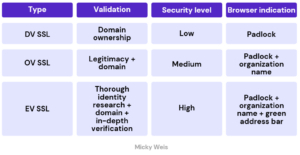
Security Considerations: Choosing the Right SSL Certificate
When selecting the right SSL certificate, it is essential to assess your business’s online needs: how many domains require protection, and to what extent is sensitive data exchanged between users and your business?
Additionally, users today are increasingly aware of secure domains when making transactions. The presence of a padlock icon and an organization’s name in the URL has become a strong indicator of a trustworthy website.
How SSL Certificates Work: A Technical Overview
For secure communication between a user and a website, an encryption process is required. This is exactly what SSL certificates achieve on a technical level.
SSL/TLS encryption ensures that data transferred between users and websites remains secure. This prevents third parties from intercepting sensitive data while simultaneously verifying the website’s identity and authenticity.
Maintaining and Updating Your SSL Certificate
SSL certificates have an expiration date and must be renewed periodically (typically every 1-2 years, depending on the provider).
Failure to renew an SSL certificate can negatively impact user trust and website conversions. An expired certificate will trigger a warning message for visitors, stating that the site is not secure, leading to a high bounce rate.
Setting up reminders and automating SSL renewals is crucial to maintaining a secure website.
Benefits of SSL Certificates for Your Website
SSL certificates help websites comply with security requirements related to encrypted communication and payment processing. However, they also offer additional benefits beyond encryption.
An SSL certificate allows browsers to establish a trusted HTTPS connection with your website, allowing users to access your website without security warnings.
For users, the certificate adds credibility to transactions by displaying the padlock icon, instilling confidence in the website.
From a SEO perspective, Google has confirmed that SSL certificates play a role in search rankings, making them beneficial for website visibility.
Step-by-Step Guide to Purchasing and Installing SSL Certificates
To obtain an SSL certificate, it must be purchased from a Certificate Authority (CA).
The choice of certificate depends on what best suits your business needs.
Once you have selected a certificate, the next step is to generate a Certificate Signing Request (CSR). In most cases, your web hosting provider can assist with this process.
After generating the CSR, it is submitted to the CA, and depending on the certificate type, different validation processes will take place.
Once validation is complete, you will receive your SSL certificate, ready for installation.
SSL and SEO: How SSL Affects Your Search Engine Optimization
As mentioned earlier, Google values secure websites and considers SSL certification a ranking factor.
Beyond direct SEO impact, SSL certificates indirectly influence search rankings by reducing bounce rates. Websites without SSL certificates may display a “not secure” warning, discouraging users and leading to higher abandonment rates.
A secure website with a visible padlock icon provides a seamless user experience (UX), which ultimately improves SEO rankings.
Troubleshooting Common SSL Certificate Issues
Some of the most common SSL certificate issues include:
- Certain website elements are not secured by the certificate. This means that images or other content might load over an insecure HTTP connection while the rest of the site runs on HTTPS.
- Your web server does not support the specific SSL certificate, requiring an update to its configuration to install modern and more secure versions.
- Your SSL certificate has expired, compromising the security of your site. In this case, renewal should be prioritized immediately.
To prevent these common issues, it is essential to monitor your certificate and ensure timely updates.
The Future of Web Security: Trends in SSL/TLS
Web security is constantly evolving, and SSL/TLS certificates remain at the forefront of this development.
In the future, we can expect more advanced certificates and a trend toward shorter certificate lifespans, requiring more frequent updates to maintain high security standards.
End-to-end encryption is also becoming increasingly necessary for various businesses, ensuring that encryption applies to entire websites rather than just specific domains.
Staying up to date with these developments is crucial for website protection and maintaining user trust.






Comments