




I’ve just come back from an inspiring trip to Asia, where I’ve had time not only to write this blog post but also to work on new teaching material and outline a plan for future content.
In general, I’ve spent time reflecting on what I want to offer you—as a reader—over the coming months.
I frequently receive countless requests for industry-specific content, and there’s clearly a high demand for posts that focus on particular sectors and business types. I truly apologize for not always being able to respond to every message, but rest assured, I hear you—loud and clear!
I’m doing my best to produce as much material as I can, and I try to meet as many of your content requests as possible.
So here’s a fresh post—written on a Qatar Airways flight between Vietnam and Denmark, returning from one of the most eventful journeys of my life.
I hope you can feel that my energy levels are recharged! 🙂
The app market is moving at lightning speed
Even as I sit in a plane flying at around 900 km/h, I still can’t keep up with the explosive growth of the app market – it really is moving that fast!
Naturally, every business wants more visibility. But visibility in the app marketplace is no easy feat, especially when you consider how many apps are now available—just look at Apple’s App Store, for instance.
That’s why we’re facing several challenges when it comes to getting apps noticed. I’ve worked with a range of apps myself, and in this post, I’ve gathered case studies and insights from my own experience in the field.
There’s more than one way to succeed and as always, my content is rooted in real-world experience. I’m sure there are other paths to success, but here are my personal tips and tricks.
Let’s dive in!
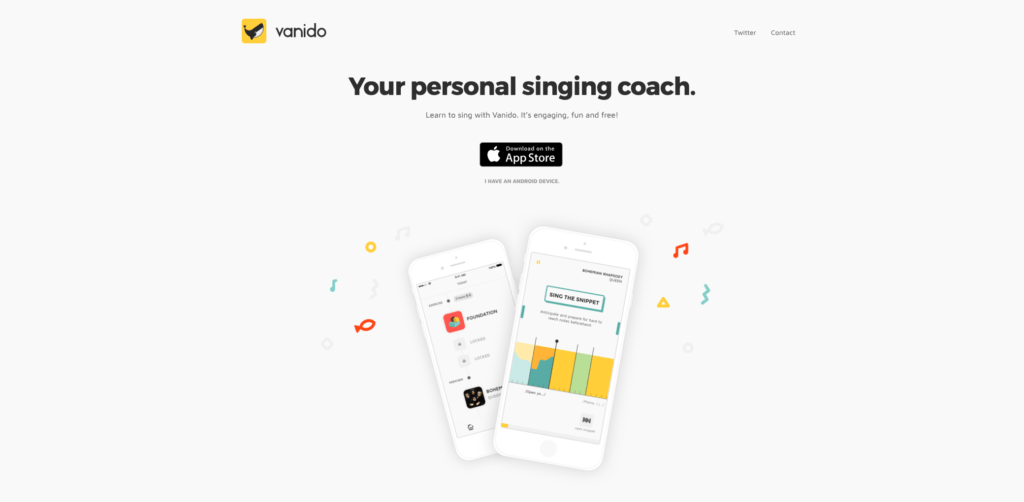
Landing page for an app
The landing page is crucial! In my opinion, it’s absolutely essential that you have a strong landing page that lets you direct users to a location where they can download your app. On this page, you can also elaborate on the app’s purpose and highlight its value to users.
Of course, you can choose to code your website from scratch… But if you’ve been following me, you’ll know I’m a big fan of using templates. This allows you to launch your product faster and get to the important stuff right away.
Always think MVP = Minimum Viable Product. Ask yourself: how can I get a product out to market as quickly as possible instead of overthinking the product or project? Most never even launch. Execution is everything.
Once you have a landing page, you can also take advantage of the space to publish blog posts, for example, that drive traffic through Google (search engine optimization). A combination of content marketing and SEO can generate great results. In other words, a solid landing page attracts traffic and builds brand relationships.
Below you can see a screenshot from Vanido’s website.
App installs
The most important thing—at least in the beginning—is to get some installs. These give you valuable insights into how users interact with your app. We’re talking about user behavior here.
Consider this as a unique opportunity to identify how you can improve and expand your app. Launch your product—as in, your app—as soon as possible so it can be tested by real users.
I often see companies stuck in endless development loops, which results in never actually launching the product. Sometimes the whole project never sees the light of day. What a waste, right?
Advertising
There are many ways to gain new downloads. You don’t necessarily need to rely solely on paid ads via online platforms. But today, I’ll focus on the media that, in my opinion, you can use to start getting downloads today.
That way, you can get started with low costs while still getting genuine and valuable feedback from real customers.
Advertising via social media
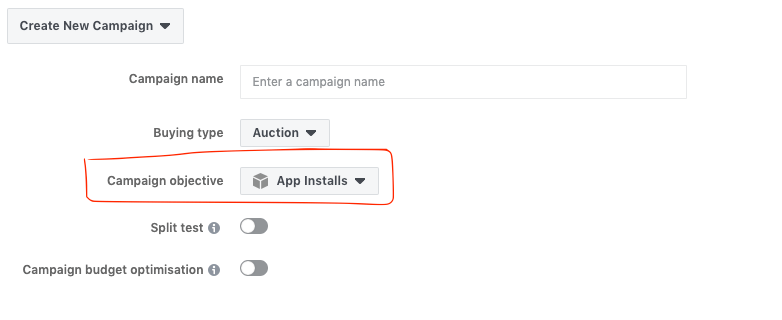
I often work with Facebook and Instagram ads when the goal is to increase installs—surprise! Or maybe not…
The great thing is that you can integrate these platforms with your app and run install-focused ads directly.
3 examples of targeting:
- App for parents
- App for teenagers
- App for dog owners
In other words, you have a direct communication channel with your audience, allowing you to speak to your target group in a way that resonates—and reach the users within your desired segment.
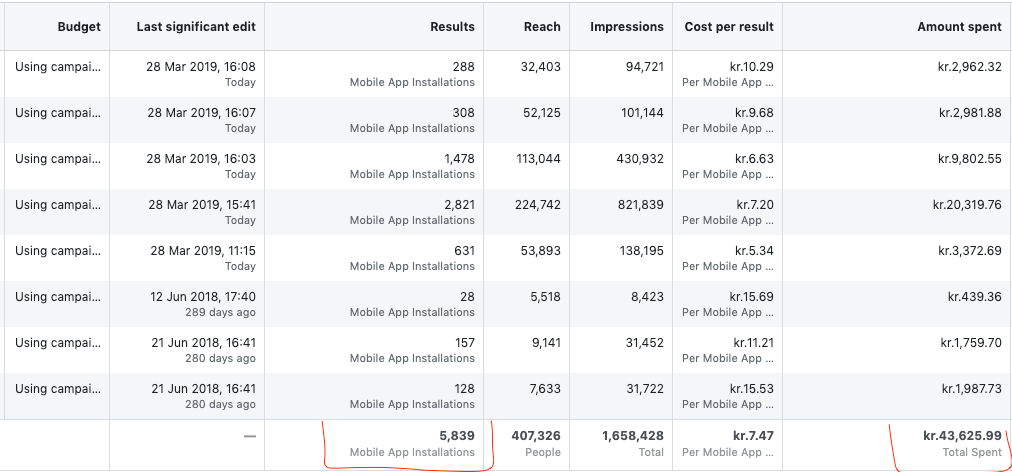
As you can see, this kind of project can result in quite a lot of downloads via social media—and at a good cost (CPI – Cost Per Install). It’s then our job to analyze that data and user behavior so we can continuously improve the in-app experience.
Advertising via Google Ads
Google Ads is constantly adding new features – just like Facebook does on its platforms
It’s not always easy to direct users to an app through Google Ads, since users typically search for solutions to problems on Google, whereas social media can create interest before a user even starts searching.
Still, with some creativity, you can set up ads that make it easier for users to download an app after searching on Google.
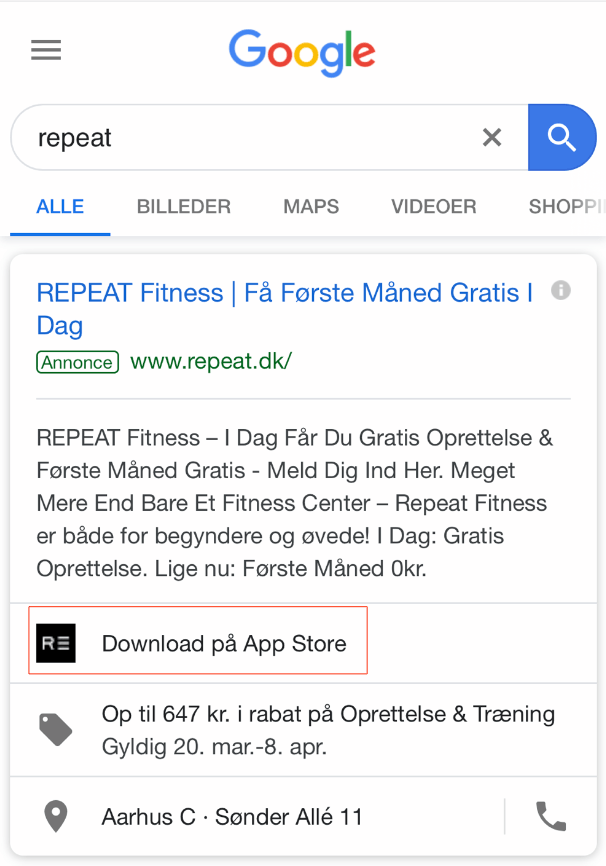
A colleague of mine, Kristian—whom I’ve worked closely with on Amazon marketing—has done just that for REPEAT.
REPEAT is a fitness chain, and their app is a key part of the user experience. Members need the app to log in and perform various tasks, so it’s essential that the app is easy to find and download.
Here’s an example of how the app download link can be included directly in the ad, which also increases the ad’s size and improves brand visibility.
Advertising via Apple Search Ads
There’s also a search engine inside the Apple App Store. I haven’t worked extensively with this yet, but my experience so far is that users often search for specific apps after being inspired elsewhere. So in the cases I’ve handled—or am currently working on—we haven’t seen a significant impact from using these ads.
In principle, this platform works like any other ad system: you set up ads, the algorithm runs, and you pay per install.
App store optimization – ASO
There’s a lot of buzz around app store optimization—ASO. Personally, I’m not a big fan of all the hyped-up digital terms constantly thrown around in this industry. I think we should avoid selling smoke and mirrors or convincing people they can game the system without creating a great product.
Let’s be honest: a good app will rise to the top in the App Store or Google Play Store if users like it. That’s it.
That said, more and more apps are entering the market, and it is important to make your app appealing—especially in competitive markets.
There are tons of guides out there on how companies claim to have optimized their app store rankings. I’m not saying you can manipulate the system—or that you should.
Instead, focus on making your app as attractive as possible. That’s what matters.
Here are a few things I believe deserve special attention:
Your app title
Make sure the title of your app is engaging and makes sense. You may not have a tagline, but it’s smart to include one—rather than just using the app name.
Next time you’re browsing for an app, ask yourself: what made me download this one instead of the others?
Here’s a caricatured example:
- Snooze
- Snooze – Sleep better & analyze your sleep cycle
Description
Make sure your description is clear and purposeful. Have a problem-solving approach. Most users are looking for an app that can make their life easier—or solve a specific problem. Like removing imperfections from Insta photos… Just kidding. But still.
Example taglines could be:
- Training on the go? 200+ bodyweight exercises, no equipment needed.
- Spending too much? Here’s how to gain control over your finances.
- Tired of being single? 200,000 others found a date via xxx.
App icon
Companies often overlook how important their logo and color choices are for the overall brand experience. Look at major brands—they go to great lengths to follow their design guidelines, staying consistent with fonts, colors, and visual identity. Digital magic is about tying everything together—including visuals.
Screenshots of the app
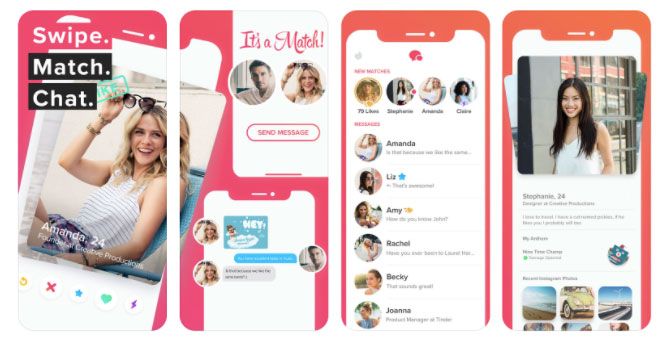
Make sure you take good screenshots—or even videos—so the user thinks “wow, I need that.” It all comes back to solving a problem. If your visuals demonstrate that clearly, you’re one step closer to another download.
Also, keep those images and videos updated so users don’t get a mismatch between the promo and what they actually experience in the app.
You don’t want them to think they downloaded the wrong thing.
Below you can see how Tinder has set up their screenshots (2017)
Reviews
Whether we’re talking TrustPilot, TripAdvisor, or Google Business – reviews are often the deciding factor. Are you offering a product, service, or experience users love? If yes, you’ll get good reviews. If not… well, brace yourself for the red warning signs.
That said, you can encourage users to leave a review in your app. Often, this is programmed so that users with high engagement get a pop-up or notification prompting them to review.
Of course, it varies by app how easy it is to get users to leave a review. But if you can collect reviews—especially good ones (and of course they’ll be good because your product rocks!)—they’re worth their weight in gold.
Remember, you can also use these reviews in your marketing to build social proof and show other users that your app is, in fact worth downloading.
Data analysis for apps
An app is built on data. In fact, to such an extent that it can be difficult to figure out which numbers to focus on—and which to ignore. The level of attention given to this is highly individual and often depends on the resources available.
Below, I’ve compiled the observations I’ve made regarding data and analysis, specifically in relation to apps.
It’s very important to remember that the number of people downloading your app isn’t necessarily the most valuable metric to focus on. There are many other aspects of the data you collect that should take priority when your core product is an app.
I’ve attended many board meetings and investor presentations where these numbers are highlighted. It’s clear that there is now a strong focus on how difficult it is to get users to try a new app—and even more so, to use it actively on a daily basis.
Ask yourself: How often do you download a new app that you end up using consistently?
Not that often, right? Below are a few of the most common terms I encounter when working with online marketing for apps.
Downloads
When running ad campaigns, it’s relatively easy to get downloads if you’re strong on the creative side. But a download doesn’t necessarily equal an installation.
Nor does a download mean you’ve acquired an active user. Be careful—especially in front of investors—when using “number of downloads” as a metric. It often looks inflated once you see how few active users are actually in the app.
Installs (number of installs)
The number of people who choose to install your app is more important. It’s a deliberate action from someone who actually wants to explore your app. Still, it’s not as valuable as, for example, an active user—which we’ll get into shortly.
User flow
You’ve probably forgotten how you got started with the last app you installed. Most major apps today—like Google, Facebook, LinkedIn, and Twitter—have mastered their sign-up flow.
It’s similar to thinking like a webshop: how many users add items to their cart, enter payment info, and complete a purchase? These are the kinds of questions we ask in e-commerce.
With apps, however, it’s slightly different. We might not just want users to create a profile—we might want them to become good users by entering as much information about themselves as possible.
Example:
- Twitter didn’t become a strong platform until users were prompted to invite their friends. Similarly, think about what you want from each user. Can one user turn into five? Is it more valuable to have fewer users with rich data than many with little?
This often requires testing your sign-up flow and identifying where users drop off during the process.
We’ve become so used to logging in via Facebook that this method now accounts for roughly 50% of new user registrations. It saves time and avoids the annoyance of entering an email and password. In short: consider your login options.
DAU – Daily Active Users
There’s a huge difference in how often users interact with apps. For apps like Facebook and Instagram, daily active user counts are naturally high, since people rely on them—arguably too much.
This makes DAU a critical metric for platforms like Facebook and Instagram. Is activity rising or falling? Are there demographic or geographic shifts? Can these be influenced?
Take SnapChat’s launch, for example—it quickly captured the 13–17 age group, causing measurable changes in Facebook’s numbers.
MAU – Monthly Active Users
Not all companies need to track daily usage. Some apps are only used occasionally, like travel apps, which are relevant only when people are planning trips. So it may not make sense to track daily users year-round but rather during key travel periods.
Time in app
Let’s be clear: we don’t want users spending more time in your app simply because it’s hard to navigate. Instead, we want to retain users.
Facebook knows that the more time we spend in their app, the more ads we see or click—and the more revenue they generate. As a result, apps often include psychological triggers designed to keep us engaged.
This is one reason why some tech leaders question whether increasing technology use in education is actually beneficial.
Additionally, “time in app” is an indicator of how much users enjoy your product.
Retention rate
This one is a favorite—not just for apps. How often do users open your app? Do they download it and only use it once? What about those who use it regularly—how do they behave?
Retention is key to building the user base needed in the early stages of an app’s life cycle.
When launching new features, it’s important to track whether they improve or hurt retention. You don’t want to add barriers that reduce the desire to return to the app.
In other words: what percentage of users use your app regularly? Once the app has been live for a while and has enough users, you’ll start to see patterns between your super-users and your one-time users.
Churn rate
Churn rate is the opposite of retention: it’s the number of users you lose each month. Some attrition is inevitable. I’ve seen sharp spikes in churn when apps start charging for features.
That’s why it’s an important metric to track. Like retention, it gives insight into whether your features are pushing users away and increasing churn.
Cashflow / Revenue model
This is always a tricky area with apps – why? Because not every app has a clear revenue model. It can be extremely difficult to build an app people are willing to pay for.
We’re loyal to the few apps we already use, and we rarely want to switch – let alone pay. Still, having control over monetization is crucial. Not only is it central to your business, but investors will scrutinize this closely.
You can analyze the difference between paying and non-paying users. What defines the ones who pay? Maybe your ad targeting needs to be refined.
There are many monetization models for apps:
- Headspace charges an annual fee to access their meditation content. Their data likely shows this works best.
- Tinder offers monthly, semi-annual, or annual plans depending on the user’s preference. They also use micro-payments for quick boosts.
- Games often rely on micro-payments. Users end up in loops where they must upgrade to advance. Six kroner for a better tractor in Farmville may seem small, but with a million monthly users, that adds up fast.
Don’t assume users need to pay upfront. Sometimes, it’s better to let them use the app and offer compelling upgrades later. Charging too early can drive users away.
Goals
Setting goals is essential, but these are highly individual depending on your business. For a social media app, the focus might be on active users, new downloads, or time spent in the app.
For a travel app, goals might include how many users downloaded boarding passes, checked in online, or upgraded to business class. The key question: are we solving their needs better or worse?
Goals should always be defined from the beginning—before starting on marketing or data analysis. Your goals should reinforce the problem you’re solving for users and naturally align with your marketing efforts.
Growth Hacking in apps
Growth hacking is a hot topic in the app world. Personally, I’m not a fan of claiming growth hacking is the path to private jets and billions of users.
To me, growth hacking is a mindset—a series of ongoing experiments that sometimes result in exponential growth.
It’s about launching new initiatives and staying agile. That often means killing your darlings.
We’ve all had ideas we thought would change everything – only to watch them flop. Kill it.
The idea is to run many experiments and monitor what works and what doesn’t. Here are some useful questions when applying growth hacking to apps:
- Can one user become ten? (invitation feature)
- Can we integrate with major platforms to simplify onboarding?
- Can we involve users in development to build loyalty?
- How do we encourage users to provide more information?
These goals can be broken into specific actions. Then, determine implementation timelines and assign responsibilities.
Avoid overcomplicating ideas and involve the whole team. Sometimes, customer support hears feedback that leads to your next big user experience breakthrough.
Here’s a framework I use with the companies I work with—set up in Trello.

Not every hack will create exponential growth. Treat it as a numbers game: launch 50 hacks a year, and that’s 50 opportunities to improve or grow your business. Don’t overthink it—execute. That’s what works.
Tools for app marketing
As the app market has rapidly expanded, so has the number of tools for optimizing your marketing efforts.
There’s always debate in digital marketing about which tools to use. Rather than fuel that debate, I’ve simply listed the tools I personally work with.
In my opinion, be cautious about using too many tools. It’s easy to get lost in the options. One of my responsibilities as CMO at Firtal Web was to monitor our tool usage to avoid overspending each month.
Amplitude
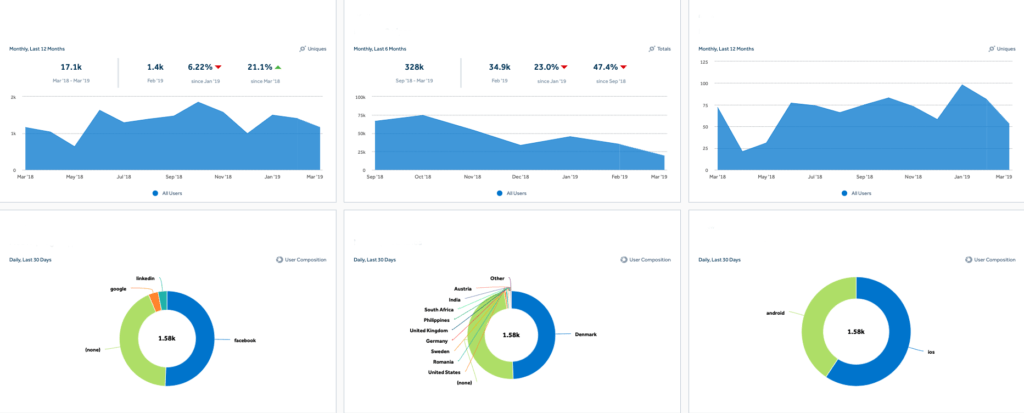
Amplitude is one of my favorite tools because it’s easy to set up and extracts the exact data you want to analyze. It’s not quite as plug-and-play as a webshop dashboard, because every app is unique. But you can still have a developer pull the relevant data into Amplitude.
Below I have anonymized some data to show a dashboard that is live.
Firebase
Firebase is essentially Google Analytics for apps. As usual, Google offers strong tools, and Firebase is helpful for optimizing and analyzing apps.
That said, I wouldn’t call it a must-have. It’s critical to have some analytics tool in place, but the right choice depends on your app, the data you want to track, and your available resources.
Most teams I work with are startups. In startups everything moves fast, and you don’t have a dedicated data team to run endless analyses.
Back to basics: use the systems that make sense for your team, and identify 4–5 key data points to track. In the beginning, the main goal is to get your app out there, gain traction, and adjust the course as needed.
Conclusion
Phew… that was quite a ride. It felt good to get back into writing again. And the office was 10 kilometers up today, which only added to the inspiration.
Did you enjoy reading this blog post?
Feel free to leave a comment if you have ideas or feedback on app marketing. There are many roads to Rome, but none of them are without challenges – remember that.
Achieving success with an app today takes a lot. We’ve gotten so used to the apps we already have that the idea of downloading and learning a new one feels overwhelming.
So… if you were to build an app today—what would it be?
App marketing and ASO FAQ: How to drive mobile downloads
What is app marketing, and why is a great app not enough anymore?
App marketing is your complete blueprint for driving visibility, securing downloads, and acquiring the right long-term users.
Even if your app is absolutely genius, it will instantly drown in Apple’s App Store and Google Play, which are currently saturated with millions of competitors.
If you aren’t actively running paid ads and optimizing your app store presence, consumers simply won’t discover your product, no matter how great it is.
How much does it cost to get a new user to download my app?
Cost varies significantly depending on your specific app category, but on average, expect to spend between $3.50 and $6.50 in ad spend to acquire a single user.
That is why user acquisition isn’t just about chasing the highest volume of cheap downloads; it’s about targeting the right audience.
A higher-cost install from a user who actively engages with your app is infinitely more valuable than ten cheap downloads from people who delete it immediately.
Why should I build an app landing page instead of linking straight to the App Store?
A great landing page acts as your digital storefront, allowing you to showcase your app’s visual world, explain key features, and build trust.
Data shows that guiding potential users through a beautifully designed landing page first, rather than dropping them straight onto the download pages of Apple or Google, can boost your overall download conversions by up to 30%.
How can I rapidly test my app idea without spending a fortune on development?
You need to operate with an MVP mindset, focusing entirely on a Minimum Viable Product that is just functional enough to launch.
Leverage pre-built website templates (from platforms like Themeforest) to spin up your landing page and get your app into the hands of users the second it can handle the core basics.
The goal is to test your concept in the real world with actual customers, rather than burying the project in a drawer and overthinking the minor details.
Which channels should I prioritize with my ad spend if my budget is limited?
Start with social media advertising on Facebook and Instagram (Meta), as their campaign ecosystems are incredibly optimized for driving app installs.
You can begin with a modest daily budget to test exactly how your target audience reacts to your creative assets.
Let your campaigns run uninterrupted for at least a week to give the machine-learning algorithm enough time to optimize and learn who is most likely to click and convert.
Why is TikTok such an effective channel for driving app downloads?
TikTok is a goldmine if your target audience is under 35, primarily because the video content feels authentic and native rather than like a traditional corporate commercial.
If you can create short, high-energy videos that showcase your app in action within the first two seconds, you can capture highly cost-effective installs.
The golden rule here is to speak eye-to-eye with your viewers and avoid overly polished corporate videos.
What is the difference between ranking high on Google vs. ranking high in the App Store?
While Google search centers on answering broad informational queries, App Store Optimization (ASO) is focused entirely on maximizing your conversion rate inside the app marketplaces.
While you still need to place your primary keywords naturally in your title and description, modern store algorithms prioritize user behavior above all else.
If users consistently leave positive reviews and actively use your app, the platforms naturally reward you with a top-tier organic ranking.
How important are the app icon and screenshots when a user is deciding to download?
Your app icon is your primary visual brand asset, it needs to stand out from competitors and look modern, while your screenshots from the app in action are the absolute closing argument for the download.
Your first two or three screenshots must capture attention instantly and explain the app’s core value proposition with short, snappy text overlays.
If your visuals look outdated or are difficult to decode at a glance, users will immediately scroll past to the next option.
How do I encourage my users to leave high-quality reviews?
Ratings and reviews are the ultimate form of social proof that convinces new users to hit download.
You can easily program an in-app prompt to request reviews, but your timing needs to be flawless.
Never interrupt a brand-new user; instead, trigger the request the exact moment they have a highly positive experience such as right after completing a workout, saving money, or unlocking a new level.
Is it harder to measure mobile marketing performance under modern privacy rules?
Yes, tightened data privacy frameworks from both Apple and Google mean the vast majority of mobile users opt out of cross-app tracking.
This makes mapping the exact, linear customer journey significantly more challenging.
The play here is to aggregate your data into a unified dashboard like DashThis and design your onboarding flow to encourage early in-app profile creation, allowing you to track retention and engagement internally.








Comments