





The AIDA model – a classic that still works
Today, we’ll take a look at one of the best-known communication models called the A-I-D-A model.
The AIDA model is mainly used for creating, analyzing, and fine-tuning advertising campaigns for businesses.
The model consists of four essential effects (Attention, Interest, Desire, Action) that a company aims to achieve with its consumers through a given advertisement, often depicted in a funnel shape.
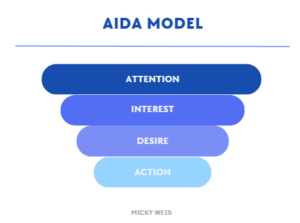
The funnel shape makes a lot of sense, as, from the first effect of the model, attention, to the last effect, action, many consumers will naturally drop off during the buying journey.
Through analysis using the AIDA model, companies can target their marketing efforts in such a way that the message reaches the target audience in the most profitable way, leaving as many consumers as possible with a desire to take the final action.
The history of the AIDA model – from the 1800s to TikTok
The AIDA model is actually nothing new. It was formulated back in the late 1800s by American advertising man Elias St. Elmo Lewis. Back then, it was used to describe what was needed to sell through newspaper ads – but the interesting part is that the model still works today.
The core idea behind AIDA has survived for more than 100 years because it is grounded in human behavior. First, we notice something, then we become curious, then interested, and finally, we make a decision. This applies whether we are standing in front of a store or scrolling through TikTok.
Today, the model has become a standard tool in marketing, communication, and branding – not because it’s “clever,” but because it works. It helps create structure in what could otherwise feel like chaos: attention battles, noise, and short attention spans.
And that’s why it’s still relevant in a digital world where a few seconds determine whether anyone even reads on.
Attention
At this stage of the buying journey, the company’s task is to capture the consumer’s attention.
This involves creating relevant advertising campaigns that immediately grab the consumer’s attention and make them aware of the company’s product or service.
Here, it’s essential to develop an advertising strategy that considers where the target audience is and where it would be most profitable to publish the campaign.
When it comes to online marketing, attention is a particular discipline that has become more complex with social media.
Here, the goal is to catch the user’s attention in an incredibly short time, as social media users tend to scroll quickly through their feeds.
In other words, a lot of planning is needed before the user’s attention is captured, for example, with a headline, image, video, etc.
Interest
Once attention has been captured, the next goal is to engage the user’s interest so that the attention is not just fleeting.
It is essential to understand your target audiences and the interests that are characteristic of them.
By segmenting your target audiences, you can narrow down which specific interests apply to each group.
Your product or service might appeal to several different interests, so the campaigns may need to be adjusted accordingly.
Interest is often gained by elaborating on what your product or service can offer.
It can also be beneficial to present consumers with positive reviews that contribute to the company’s social proof or other supplementary information.
While attention grabs immediate focus, the interest stage is where you need to hold that attention with additional information.
This is necessary to appeal to the consumer’s needs.
Desire
Attention and interest lay the foundation for the consumer to want to acquire the product.
At this stage, the consumer needs to be convinced of why they want the particular product.
Positive phrasing, benefits, and focusing on the needs met by purchasing a particular product can be used here.
According to the AIDA model, this helps emotionally convince the consumer that acquiring the product is worth it because it clearly meets their needs.
Storytelling and emotional triggers are effective tools here. It’s no longer just about functionality – it’s about attachment, identity, and the feeling of making the right choice.
Action
Now that the consumer’s desire to acquire a product or service has been established, the next step is to convince the consumer to take action.
Here, it’s essential to be clear: what specific action is desired?
Is it to purchase the product, sign up for a newsletter, contact the company via a contact form, or something else entirely?
This could be done, for example, with a call-to-action button that lets the consumer know what the next step is in obtaining the desired product or service.
In other words, consumers must be clearly engaged to take a specific action so they can convert into customers.
When does AIDA work – and when should you think further?
AIDA is a strong and logical model. But it’s not a one-size-fits-all solution. Today, where user journeys are often complex, and decisions are made over several touchpoints, it’s important to understand that AIDA often needs to be combined with other models – for example, customer journeys, personas, and funnel strategies.
That doesn’t change the fact that AIDA is still highly effective for top-of-funnel efforts and ad formats where there’s little time to make an impression. It also works well when you have a clear objective for your campaign: get attention, create interest, spark desire – and get a click.
How to use AIDA
What’s smart about AIDA is that you can use it as a checklist when developing content:
- Do I have a strong hook that captures attention?
- Do I explain what the recipient will get out of it?
- Have I created a real need or desire?
- Is there a clear action I am asking for?
You can also use the model to analyze competitors’ campaigns. Where are they losing people? Where are they succeeding? Where can you do better?
AIDA in new formats – how do we use the model today?
AIDA is no longer only relevant for text ads and campaign pages. Today, we see the model used in:
- Social media: A video ad can start with a hook (attention), show a problem + solution (interest), present the product emotionally (desire), and end with a CTA (action).
- Emails: The subject line = attention, the intro = interest, the case or USP = desire, and a clear button = action.
- Landing pages: The layout can directly follow the AIDA structure with headline, problem explanation, solution, and action at the end.
The point is: the model still lives – you just need to know how to use it in the media and format you are working in.
Final thoughts
AIDA is not old wine in new bottles. It’s a fundamental human understanding: we notice something, we get interested, we desire it, and then we act. In a world full of distractions and noise, it’s more relevant than ever to think structurally in your communication.
So, next time you create an ad, a landing page, a video, an email, or even just a simple headline – ask yourself: do I have AIDA down?
Have you had any experiences using the AIDA model? Feel free to share your thoughts in the comments below!





Comments