





“Micky, we need to kickstart growth, who should we hire?”
… What do you want to achieve?
” We want to get better at advertising, Google Ads, SEO, content, newsletters, growth hacking, e-commerce, inbound – and we just need some talented people. ”
Can you relate to the above?
I can. Over the past 10 years, there has been a rapid development in the Danish marketing scene – in fact, across the entire world.
The demand for competent employees in the digital space has exploded, while the supply still lags behind.
There are many reasons for this.
The first is, of course, the explosive technological development across nearly all industries worldwide. Add to that the lack of formal education in the field, which is still in its early stages, and finally the pandemic, which acted as gasoline on the digitization fire.
So the shortage of employees is evident – not least in my work as a consultant, where I have helped build organizations, hire employees, and become part of various organizational structures, which I will return to.
In this post, I will share my perspective on how to structure a marketing team and how the different roles, in my view, should be understood.
1. You don’t know which role you are looking for, but you want growth
Often, you see job postings like:
- Paid specialist
- E-commerce specialist
- Growth hacker
- Digital marketing manager
- Facebook ads expert
- Google specialist
- CMO (Chief Marketing Officer)
- Head of growth
Yes, beloved children have many names, and it is rare to find one person who possesses all these skills.
It is practically impossible.
So before we move on, let me try to divide these many “faces” into two groups: generalists and specialists.
Traits of generalists
Here you often find CMOs, E-commerce managers, Digital Marketing Managers, Heads of Growth. This is naturally a bit caricatured, but let me explain: people in these positions typically lead a team and have external support from agencies or freelancers. Therefore, they do not need to be specialists themselves.
A CMO usually has leadership responsibility and, as head of the marketing team, is also accountable for growth. He is not responsible for executing Facebook ads or writing content. These roles often require years of experience, either from running their own business or from building on a specialist role.
Many of the marketing directors (CMOs) and managers I know started as specialists, but later discovered they were better suited as leaders, or it was simply a natural career development in their company.
This role usually makes sense only in a larger organization; otherwise, in my view, it is not really a “Chief” role.
If you are CMO in a startup with three people, who are you chief of? In my eyes, that comes across as unserious.
Another key trait of this role is the ability to structure teams – delegating tasks with one clear goal: growth. They often have dashboards and KPIs as their direct reporting line to the CEO. It is not always an advantage to lead based solely on KPIs, especially those employees cannot influence – it can even be demotivating.
A CMO can easily have an E-commerce Manager in their team, depending on company size. I will elaborate more on this in my organizational structure section.
Naturally: the larger the company, the larger the “tree,” depending on the industry. A B2B software company may need a smaller marketing team than a webshop with 20,000 products. In other companies, there may be a greater need for Key Account Managers because of complex products.
Finally, responsibility for external services often falls under this role. That means the CMO can easily manage an agency that acts as the “specialist” for a specific discipline. This is common today, as many companies struggle to find true “paid specialists.”
If you are a director and have found the right person for this position, my best advice: get out of their way. I have seen too many good strategies and skilled people drown in directors’ opinions or bureaucratic leadership despite the directors not being qualified within digital.
Traits of specialists
A specialist typically focuses on one branch of online marketing – for example, paid advertising, or even more specifically, Facebook Ads. While they often have a broad understanding of digital marketing, their core area is one specific discipline.
These roles are often brought into a company because that channel has a significant impact on revenue. In Denmark, Google and Facebook (including Instagram) account for the majority of digital ad spend. TikTok, Twitter, Pinterest, Snapchat etc. are still behind but steadily growing.
Many specialists can be found in the consulting world, as I come from, and especially in agencies. It resembles the legal industry in this respect: agencies are often built around specialists offering their expertise to companies.
One reason for the shortage of specialists in Denmark is that large agencies scoop up talent. Agencies allow people to work across cases and avoid too rigid roles compared to in-house positions.
Growth Hackers & Head of Growth
Growth hacking is a term that emerged a few years ago and, in my opinion, better reflects what many companies are actually seeking: growth. Most are still unsure of what competencies they lack, so they put everything under this umbrella term.
But here lies a risk: perhaps the company needs a Google Ads specialist, but there may not be more to gain from that channel – even if they hire the best in Denmark. The gain might only be 10%, which is not always impactful.
A story: I was once a strategic external partner on a large e-commerce project in the Middle East. After securing a major investor, they were convinced they could just increase their Google Ads budget by 300–400% and achieve equivalent growth. They hired extremely expensive experts, but revenue did not follow.
There simply wasn’t enough market volume. They needed other levers, such as internationalization.
Or another often overlooked skill: creativity.
A growth hacker tests and tests. Most companies I have worked with spend 80–90% of their time inside Facebook, Google, Snapchat dashboards looking at revenue. They forget to be creative.
I often challenge companies by saying: This week you are not allowed to look at your paid channels. Pretend you can never use them again. What will you do now? After some irritation, suddenly a wave of ideas appears.
2. Remote vs culture
The digital industry is probably the one most recognized for “remote work.” “Digital nomad” is one of the most popular “positions” one can have in modern society.
In my view, there is no definitive right or wrong answer here; it naturally depends on the company.
However, there are a few things I would like to add, having seen most of what goes on in this digital stratosphere.
Remote – digital nomads
Today, you can hire people anywhere in the world. I have personally worked from the Middle East and the US for long periods of time while having clients back in Denmark, and vice versa.
It has become more widely accepted not to sit in an office, especially not in the classic 8-to-4 framework.
But there is one problem with this if you are a company in growth: communication.
If you want success with digital nomads, as we call them in plain Jutlandic, structure and processes are absolutely critical.
Systems such as Slack, Teams, Zoom, Trello, Asana, etc. are essential for the company to move forward like one train in the same direction. Without this, it will be like 10 different trains running in 10 different directions, because there is no structure.
It is also important to have clear KPIs, not so much because the numbers are decisive, but because when you are not sitting together, communication is often lost. Without something to work toward, my experience is that remote work can more quickly end up leading to nothing.
So: systems and goals (realistic goals, of course).
Another challenge is retaining employees. Naturally, you have a digital relationship with others in the company, but as you are not physically present in the office, it can be difficult to feel that personal connection to others.
Therefore, my experience is that digital nomads also tend to jump more between jobs. Of course, this also generally characterizes the younger generations, who are not in the same job for 10, 20, or 30 years like our parents and grandparents.
Still, I believe remote work can be used extensively. Especially if you lack the right talent in the local area where the company is based.
I have often worked with companies from Ukraine, Romania, and Hungary for technical development. Platforms such as Upwork have made it extremely easy to find employees, and I have in fact later hired several of them full-time, despite never having met them in person.
Culture
I am probably still somewhat influenced by the strong culture we had at Firtal, where I was CMO.
In my view, the right culture can compensate for many weaknesses in a company. A culture lifts a company during difficult times and can shine in good times. For me, it is a bit like a football team.
It obviously requires investment in culture.
When I have worked as a consultant in various organizations, it has been very clear when culture shines through.
There is simply a different vibe.
Systems and processes are still important, as is reducing the number of meetings and participants in each meeting. There is nothing worse than drowning people in meeting invitations, especially creative people who are supposed to drive growth.
What culture means for each company is hard to define, and I do not think it can be put into a formula. Naturally, it also varies depending on the size of the company. For me, good culture starts at the top. When I look at the success of Joe & The Juice, I often think that culture must be the main reason behind it.
Here are some of the experiences I have taken with me:
- At ZERV, they had a badminton court that was used frequently. The entire company buzzed with racket sports, closeness, and team spirit.
- At Firtal, we had a learning library, internal presentations, great Friday bars, a table tennis table, and the freedom to fail (I will explain later why that is important).
- At Puori, there was group training in a CrossFit room with protein shakes made from their own products afterward. It was all about health and a shared vision of helping people live healthier lives.
- At Molly & My, there was a spirit I cannot quite describe, but it just made you happy to come to their office. Luise and Karina’s energy permeated the entire company, and I always felt incredibly welcome.
When I see posts on Facebook from companies such as Les Deux and Rains and their office facilities, you cannot help but feel a little envious. My point with all this: start where you can with what you have. You may not have a large budget for interior design, but energy costs nothing.
Peter Drucker once said: “Culture eats strategy for breakfast” – and I could not agree more. Perhaps even more so in the digital industry, because the younger generations who will shape this industry want meaning in life. They want what they do to matter in their lives.
It is easier to create meaning for each employee if the company has clear values, vision, and a strong culture that people can identify with.
Conversely, I have also experienced dysfunctional teams where employees were afraid of the boss, did not dare to speak their mind, took more sick days, and radiated bad energy. Often these companies also performed the worst – or at least did not have a creative flow – and even worse, many people were unhappy going to work.
Honestly, I have even ended two collaborations due to poor work culture – and that was as an external consultant.
3. Reduce churn – creative freedom and education
“Freedom under responsibility” may sound like a cliché, but it still matters. Younger generations expect more freedom, the possibility of remote work, and are generally quicker to leave if they are not satisfied in their role.
This therefore places different demands on modern companies. You must create room and space for creative freedom that can be tied to the company’s overall strategy while still achieving the goals you have set.
The clearer a company’s objectives, vision, and mission, the easier it is to retain employees. To use a fancy marketing word from the digital dictionary, it is about reducing “churn” (the number of employees leaving the company).
Put simply: people should be happy with the one life they have. If you, as an owner, leader, or colleague, can contribute to that, then it must be our most important task.
In the marketing sector, there is still enormous demand for qualified labor and thus an imbalance in the labor market, which makes it favorable to search for work.
Another “fun” story: I once went to a job interview at one of Denmark’s largest companies for a Head of Digital position. The first thing the director said was: “Remember, we are taking Micky out of the equation, and you will be just a small cog in a big wheel that must keep turning.” I was stunned and thought: how do I get out of here?
4. The digital organizational chart
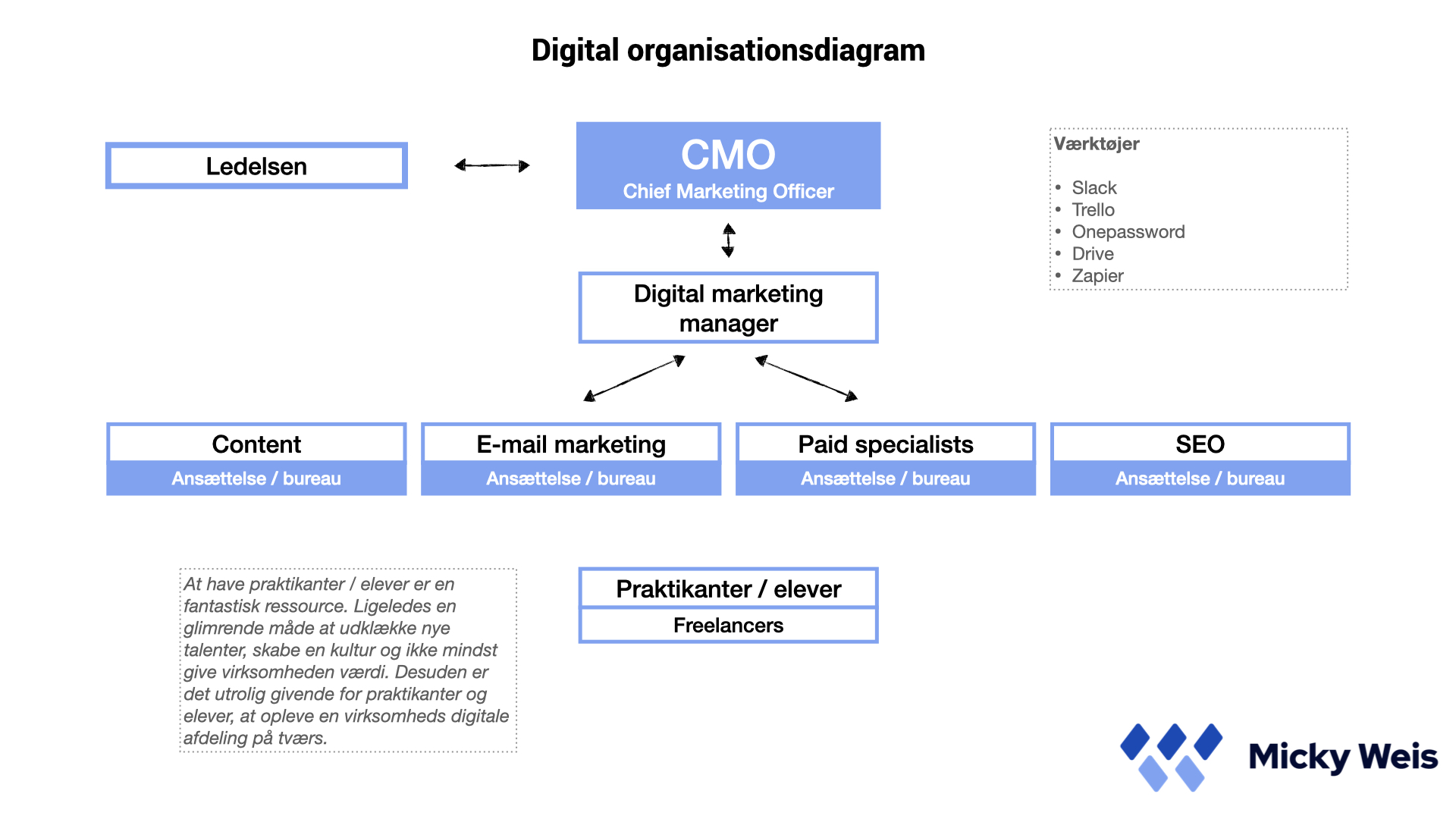
The above digital organizational chart is just a simplified example of how I have seen teams structured.
I have not included other internal teams, such as technical or customer service, which are normally closely connected. You will also often have multiple people tied to the CRM/CMS system, but let’s leave that aside for now.
The purpose here is simply to illustrate how you can make an internal team work together with external resources.
I have often been brought in as an external resource, for example as a “paid specialist” or for “SEO,” where I worked together with a team in the given company. That way I understand the company’s goals, culture, and values – which I can then use in their marketing.
I have also sat on the other side of the table as CMO, both at Firtal, Slikhaar, and Tattoodo, where I used external resources, including Kristian Scharling for content marketing and ICE Digital for SEO, just to illustrate a few examples.
So yes, external resources can definitely be used in interaction with internal teams.
5. Interaction between departments
One area I find very underestimated is the interaction between departments, especially the marketing department.
Let me give a few examples:
- A webshop: The customer service department is on the front line. They are in dialogue with the customer. There are so many good ideas, problems, and solutions that can be passed from this touchpoint to the marketing department. Errors on the website, repeated questions (if the same question is asked five times, it should be “flagged” by customer service and sent to the technical department or marketing). This way, you can fix problems, reduce customer dialogue, increase conversion rates, decrease customer service workload, and make customers happier.
- A SaaS company: In my opinion, the biggest problem many software companies face is the interaction between product people, marketing, and the technical department. Many SaaS companies employ salespeople or key account managers to handle clients, but the knowledge they gain from clients rarely reaches marketing or development teams. Here lies a huge opportunity to optimize the product and become sharper on which features to highlight in marketing to attract more customers.
6. Hiring marketing people in a startup
When starting a company, you do not have the privilege of starting with a “rockstar marketing team” where every position is filled. In my view, you should not.
At the beginning, you do not yet know what you need, so there is no reason to spend all your saved funds or investor money immediately.
In the start, it is about finding passionate people who are willing to run for your company, who fit the culture, and who, not least, have skills that complement the founders.
I have seen many examples of companies that raise investment rounds and then hire an expensive CMO profile for 100,000 DKK/month (which is not absurd in itself). The challenge is that many CMO profiles are used to joining projects when things are already running and there is “traction” – something they can scale.
It is much harder to start from scratch as you must in a startup. You have to come up with the ideas yourself, and you cannot just hire an external agency to launch your paid channels. It is about finding someone who can grow into the role of CMO over time but currently has a more “startup” profile, not trained to do things only one way.
Earlier in my career, I was labeled a “growth hacker” because I have a broad profile, having sat on both sides of the table. I am not the best at one specific channel, but across the board I can guarantee one thing: I can make your company grow. That is the profile you want, without sounding arrogant.
As you grow, you can always hire external resources to optimize individual channels.
If you want to explore the term “growth hacking” further, I recommend reading this blog post about the 50 most well-known growth cases.
Culture is one of the most important things in any startup because you end up spending an extreme amount of time together, and it is hard, especially at the beginning. Furthermore, everyone in a startup will be the company’s face externally, so it is crucial to have people who represent your company in the best way.
7. What should I pay my marketing team?
Micky, what should we pay our marketing team?
Salary is not a topic widely discussed in Denmark, so this subject often causes raised eyebrows.
I have been involved in hiring people at million-DKK salaries. Some of these hires included the possibility of becoming a partner. Often, these “salary packages” are structured in a way that retains employees long-term and increases the incentive to grow the company. When you get shares in a company, the salary is usually lower.
Instead of paying 100,000 DKK per month (fictional example), you could pay 70,000 and add a bonus package tied to realistic goals. These goals could also unlock shares in the company. I would always advise using legal assistance when making these contracts.
There is also a big difference between being in a smaller town versus a large city. Generally, salaries are significantly higher in larger cities, reflecting higher living costs.
Of course, it depends on the type of company and how many people the person will manage.
A skilled digital marketing manager’s salary will, in my experience, start from 35,000 DKK/month plus pension – and there is usually no ceiling, especially if the company is international.
Salary is not always the decisive factor. Referring to the previous section, sometimes it is the amount of freedom, the culture, future opportunities, values, and not least the product that attracts an employee.
When I accepted the job at Firtal, I could have had much better financial options if salary was my only focus, but the alignment with the company’s values was perfect. Not least because I got to work with Jesper Hvejsel, who I have long considered one of the best in e-commerce.
Remember: the right profile can be a huge resource and tip the scales in moving the business forward. In my view, you cannot put a price on the right employee. I have been part of cases where my contribution helped generate a million in revenue. Of course, you should be compensated accordingly. Sometimes, you have to take a chance – you can conduct all the hiring tests you want, but you never really know how daily work with that person will turn out.
8. Make mistakes (Yes, that cliché still holds)
Creating space, freedom, and trust that it is okay to make mistakes is extremely important.
At Firtal, we had “the cone” – a bowling cone you placed on your desk when you made a mistake. Each week, you would share what mistake you had made and, importantly, what you had learned from it.
Mark Zuckerberg previously stated that the culture at Facebook (now Meta) was “Move Fast and Break Things” (especially in the beginning; of course, as the company grows, mistakes often have bigger consequences, though they still try to maintain the philosophy).
Conversely, one could say: if you do not make mistakes, things often move too slowly, you do not take enough chances, and you allow the status quo to be “good enough.” Without wanting to sound stressful, “good enough” is simply not enough in a digital world where our behavior constantly changes.
It is a bit like life. A child tries to walk, bumps into a table, learns from it, tries again, falls – and eventually walks. The child is not scolded every time it tries; on the contrary, one more attempt, say the parents in unison.
Similarly, we must create a culture where this freedom and support are paramount.
So whether you are entering the industry or sitting on the other side of the table in your company, I am rooting for you.
One more attempt – I am confident you can do it.







Comments