




I’ve received quite a few inquiries about real-world cases, and that’s why I’ve decided to write a detailed post that aims to give you a solid idea of how to create online visibility for a specific business — my way, that is.
Last time, I wrote about a specific example in the automotive industry, but today we’re diving into: the fitness industry.
Here’s my suggestion for what an online strategy might look like for a fitness center — free of charge — so soak it all up!
I’ve chosen to focus on the most essential points, and naturally more will be added as the business grows.
Let’s get started!
Got your data in order?
If you’ve been following along here, you know I’m a big advocate for having control over your data — but not all data is relevant when running a fitness center.
I would start by setting up a dashboard system called CYFE. This tool can pull data from all other systems such as Google Analytics, Facebook, Instagram, email systems, and more.
Screenshot of Cyfe
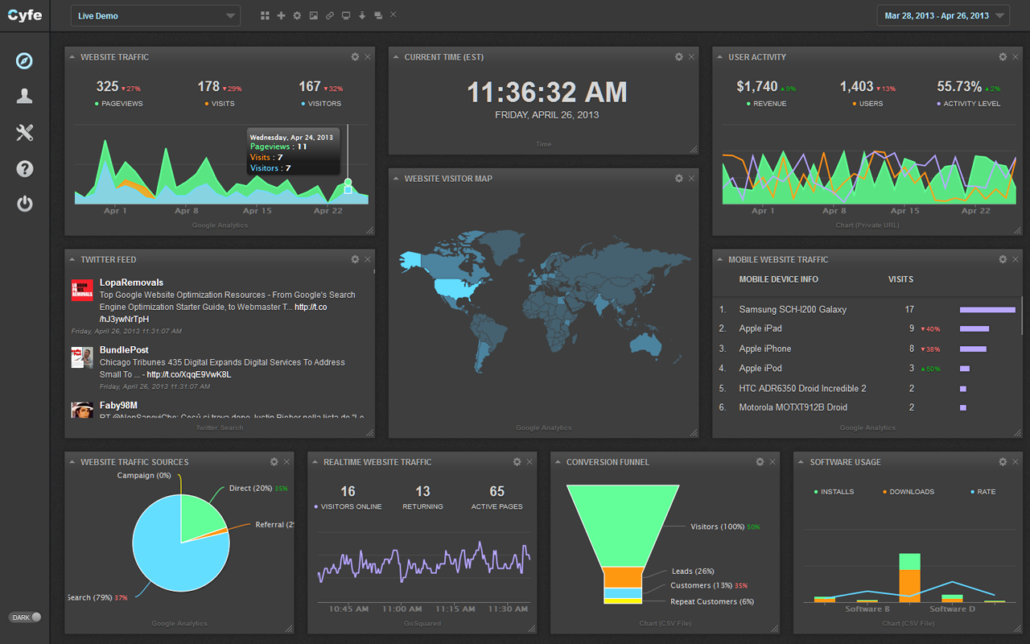
In short: Cyfe is a dashboard tool that can extract data from all existing sources — you can also create your own reports using Google Sheets or Excel and upload them to the dashboard. A dashboard will differ depending on the business. Cyfe stands out as a kick-ass tool because it simplifies the overwhelming amount of data available, giving you a clear overview of the metrics that matter most to your business.
What kind of data could be relevant for a fitness center?
- Number of website visitors
- Number of views on Facebook
- Number of new sign-ups
- Number of lost customers
- Number of new customers in-store
- Number of daily gym visitors
- Average customer lifetime
Data should be tailored to your specific business, and that actually applies across all industries — not just fitness. In other words, it’s relevant only to look at the data you can actually use.
Selling subscriptions online?
Then you need to set up goals in Google Analytics.
With goal tracking, you can determine which channels bring you new members — meaning you’ll know how to allocate your marketing budget most effectively.
Facebook marketing
Here in Denmark, we love Facebook — so your new fitness center should absolutely focus on that platform.
Read my full post on Facebook marketing
Let’s take a closer look at setup strategies!
Create the most engaging page packed with fitness inspiration, targeted to the segment your fitness center is aimed at.
Content ideas:
- Blog posts from your content marketing strategy
- Workout videos or training tips (Remember: videos perform 10–20x better than images and links)
- Contests — win a 1-year membership or a gym bag — your creativity is the only limit. Drive engagement!
Facebook advertising
You need to get your advertising up and running!
Facebook’s ad platform offers endless segmentation possibilities.
Here are some of the audiences I’d recommend:
- Fans: People who already like your page
- Website visitors: They’ve already shown interest
- Locals who like other gyms
- People who check in
- Remarketing: Upload your list of past members and retarget those who’ve canceled
- Lookalike audiences: Upload your member list and let Facebook find similar people in your area
Instagram marketing
Instagram Stories are booming right now — and you should join in!
A lot happens in a fitness center during a day, and you can showcase this on your Instagram. Use Stories to guide your followers — Instagram is perfect for showing activity! Maybe someone baked protein cake today — show it off!
Instagram is a fantastic platform for sharing health tips — like healthy recipes — because it’s so visual.
Engage your customers — they’re the ones who will attract new ones!
#yourgymhashtag
E-mail list – customer club
Emails are still personal. In fact, they’re more personal than Facebook and everything else in your digital toolbox.
Read my full post on email marketing
You need to focus on building relationships with your customers — or potential ones — and you can do that through email.
Mailchimp recently made their automation tools free. This means you can set up your email flows entirely for free.
A flow lets you tell a story to your readers — not just a boring mass email, but a narrative that builds a relationship with your potential or existing customer.
You can set up a flow via Facebook Lead Ads and your Mailchimp account. It takes a little time, but once it’s running — it works.
Content marketing
Of course your fitness center has a website, and on that website, there’s a blog, right? Rhetorical question 😉
If not, we need to get that blog going right away!
There are countless topics in the fitness industry you can write about. You probably know more than I do — but if you’re a fitness enthusiast, there should be plenty of interesting topics to explore.
On your blog, readers should have the option to sign up for your newsletter — and remember what happens then?
They enter the email flow we just set up.
Content ideas:
- Customer reflection: Have you seen the TV3 ads for Spilnu.dk? Their use of customer reflection is brilliant. Do the same! Feature 4–5 members of different age groups — you’ll appeal broadly! Then promote them via Facebook — to the exact right audiences.
- What are people searching for?: Do a keyword analysis. You can base it on other gyms or use Google Keyword Planner to see how many searches exist in the market.
See all the tools I use every month
Example from Buzzsumo:
Buzzsumo is a tool that helps you find relevant content via a URL or specific topic.
Try it yourself.
I searched for “strength training”
It returned the most shared results across social media using the word “strength training.”
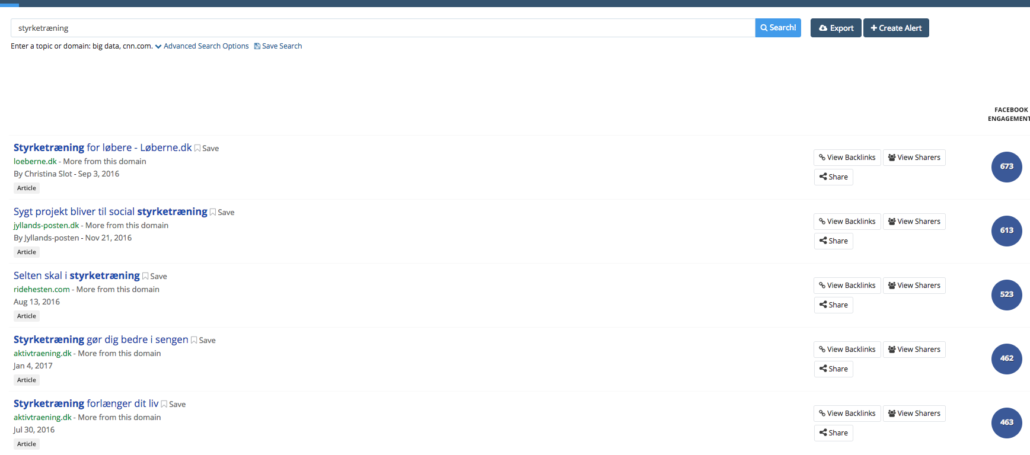
The smart thing about Buzzsumo is that you get inspiration from large international sites — not just Danish ones!
Topics or posts that have been shared thousands of times prove that there’s real interest in that subject — so now it’s up to you to create even better content addressing those areas.
The more you give away for free, the more your reader will see you as an inspiration — and maybe those readers will become members someday?
Use your internal searches
Once your site gains traction and traffic starts coming in, you can make use of internal searches (assuming you have a search function — and you do).
Once you’ve installed Google Analytics on your site, go to Behavior > Site Search > Overview.
You’ll get a long list of search terms/products/services that people are searching for on your site — this gives you inspiration for blog or social media content that adds value because it’s based on real user needs.
So, there’s another piece of “content gold” (if that’s a word — probably not) for your blog or Facebook page.
SEO – local search engine optimization
Your Facebook campaign boosts brand awareness, leading to more branded searches. Your content strategy improves your Google rankings through blog posts. The more you have, the easier it gets.
So let me ask: is your SEO under control?
Many people think SEO is only for webshops — but that’s far from the truth.
Let’s look at a few examples:
Monthly search volume:
- “Restaurants Aarhus”: 12,000
- “Fitness center Aarhus”: 800
- “Hairdresser Aarhus”: 6,000
- “Sushi Aarhus”: 5,500
And these are only exact searches — of course there are plenty of variations.
In other words, most purchasing behavior starts online, whether it’s a product or a service.
Even heavy industries are becoming digital now.
The advanced strategy – gamification
Snapchat, Instagram, Tinder — and many others — have paved the way for the gamified experience.
Of course, your fitness center isn’t a game — or is it?
Think of all the information you have about people — it’s time to help them “level up.”
Gamification has a psychological effect: we tend to stay engaged longer when we’re drawn into a game-like experience.
Start small:
Create a loyalty card connected to members’ IDs or email addresses — use this to send personalized info based on their gym behavior. People can earn badges, points, or other rewards for their achievements. They can also track how much they’ve trained over time — this is exactly what made Endomondo worth 100 million.
It could be as simple as a personalized email flow based on class attendance — the feeling of being part of something bigger is unique, and that feeling of belonging makes members want to return.
I believe we’ll see many more “customized” apps and personalized tests in the future — like advanced weight-loss calculators — because we all want experiences tailored to us as individuals.
Conclusion
As you’ve probably figured out by now, there are countless ways to build a solid strategy for your online marketing. In other words — there’s no reason not to start today.
This applies to most industries — including physical shops.
Mastering online marketing is a powerful asset — even for the local clothing store — because we Danes spend so much of our time online.



Comments