





Welcome back to the series on how to become a star blogger
This time, we will take a closer look at how you can market your blog – if you didn’t read the first part about how to start a blog, you can find the post right here.
Also remember to sign up for the newsletter on the right side, so you can receive future articles in the series, including how to make money from your blog.
Let’s get started by looking at how to get more readers!
1.Tracking and analysis
Without sounding too complicated, tracking and analyzing your traffic is a very important tool, especially if you want to make a living from it and invest in your blog. I always say that without analyzing and tracking everything you do online, it’s a bit like driving with your eyes closed.
Google Analytics
Fortunately, we live in a time where technology has made it much easier for us to track and collect data. Especially Google has made a huge effort to give us as much data as possible from our websites.
Google Analytics is a free data tool that all websites in the world can install. You can then log in to what is called a dashboard, where you get access to a wide range of data about your website.
Installation
If you have a WordPress blog, you can easily install Google Analytics. Start by creating an account at this link. Once you have created an account, you can add a new website – then click “Get tracking ID.”
You need to insert this code into your website’s code. If you don’t know how to do this, you can find help either through forums – or via this guide. I can’t explain it better than this guide, so you get the link instead.
Once you have installed the code correctly, you will shortly be able to see the numbers when you log in (provided you have traffic on your website, of course).
There will many menus you can click through. Not everything is equally relevant, but I will highlight the most relevant data you should look at if you run a blog (we’ll cover webshops another time since they have some different data to look at).
- Time on site – how long do people spend on your page.
- Traffic sources – where do your users come from?
- Bounce rate – what percentage of users leave after reading one post?
- New or returning users? – Are you good at keeping your readers?
Cyfe
Let me introduce you to Cyfe! The ultimate KPI tool for startups and bloggers. There are alternatives, but Cyfe fits my purpose perfectly, and it costs much less than most alternatives. Cyfe is basically just a tool that simplifies data from multiple sources and makes it clear in a nice dashboard.
You decide what is most important for you, which also means your team or just yourself gets clear goals to work towards.
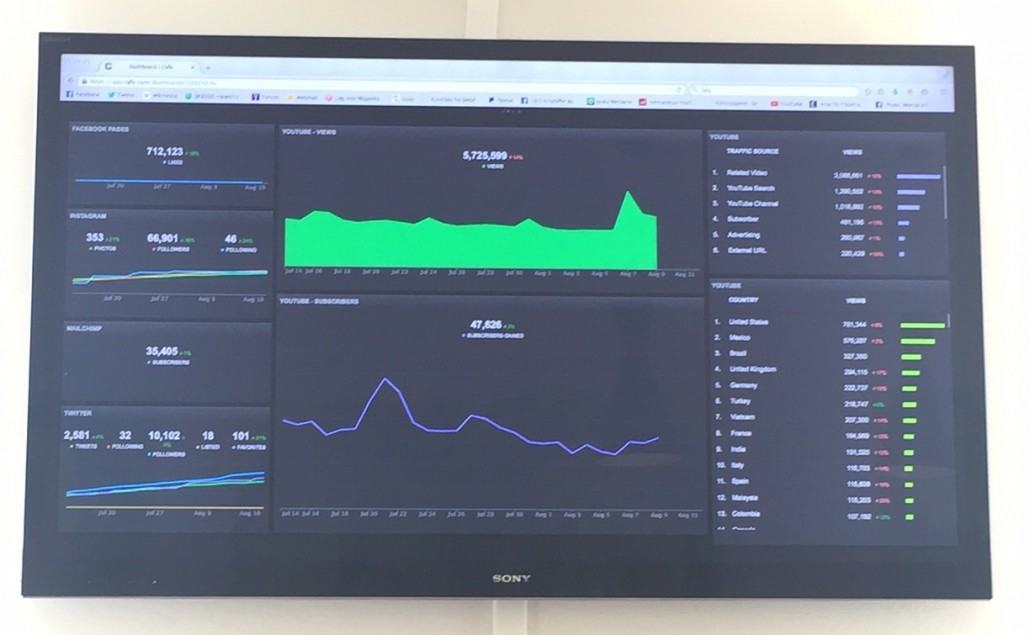
Let’s take an example from SlikhaarTV’s Cyfe dashboard.
1. Social board
Since SlikhaarTV is a social brand, their most important KPIs are tracking all social data. This could be Facebook likes, YouTube subscribers, Twitter followers, or Instagram followers. In other words, we created a board that covers the most important KPIs – which simultaneously cuts out the non-essential ones, instantly creating focus for the team.
2. E-commerce board
They need revenue. Slikhaar’s second most important business is selling products – this drives growth, as it allows them to make even cooler videos that strengthen the social board above. Therefore, they naturally created an e-commerce board covering sales figures and conversion rates, especially in their best-selling countries.
3. Traffic board
The last element they want to track is traffic. They are constantly working on improving the content part of Slikhaar’s concept, including exploring other channels besides social media. All this is tracked in the traffic board, where they can see how their site performs when posting a new blog post – very relevant for you as a blogger!
Cyfe works by letting you create widgets on the boards you want. A board is the overall category and can be called “Social board” for example, containing all the social data you want to track. Then you add a widget – it could be “Facebook” – and choose what data you want to track from that platform.
Tip: If you’re serious about your blog, don’t use counters on your site that count every time the page reloads. Anyone can see those count clicks, not real visitors. Be serious with your audience and traffic as you are with your content.
2. Guest blogging
A very underrated strategy in Danish blogging. This strategy is widely recognized abroad. Simply put, you write posts for other bloggers and thus get a share of their readers. This naturally puts high demands on one thing – your content – but if you are serious about your content, many blogs will gladly share it for you. They get content for their users, and you get your brand out there.
A good example is when Henrik Duer writes for the Danish newspaper Jyllandsposten. It gives him branding and gives Jyllandsposten readers. You might not get to write for Jyllandsposten right away, but there are many other places where you can write for others.
The Google method
Try googling your keyword together with guest blog.
Examples:
- “training” + “guest blog”
- “supplements” + “guest blog”
- “health” + “guest blog”
- “marketing” + “guest blog”
- “recipes” + “guest blog”
Often, this method lets you find others who have guest blogged on various websites. Note them down in your Wunderlist as mentioned in the first part of this blog series, or use Excel if you want a systematic overview.
Tip: You could also challenge yourself and write for an English medium. It requires a bit more, but the chance of getting thousands of readers is quite high, and many accept guest posts.
Write a SUPER good post
Imagine you are about to give a talk to 10,000 potential new customers – that’s basically what you do when writing a guest post on another website – so your post must be top notch! There are some tools you can use for this.
Start by going to Buzzsumo and enter the URL you want to write for. For example, I just entered Woman.dk – and it shows the most shared posts from Woman.dk. Do the same for 4-5 competitors in your niche and gather these results in an Excel file.
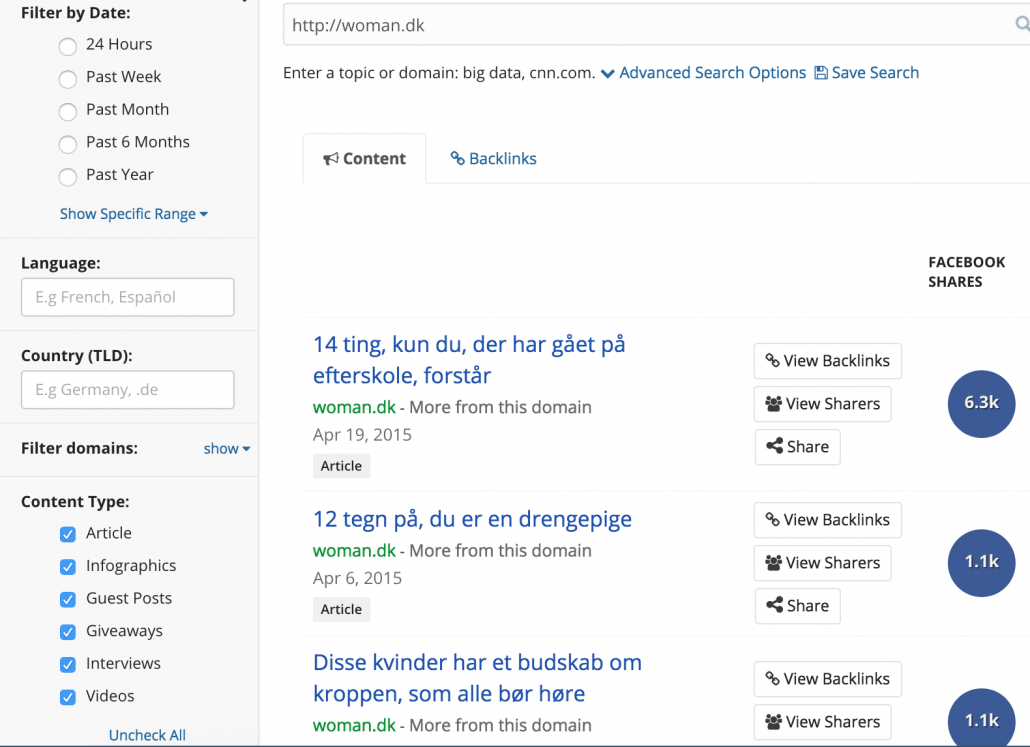
I hope you didn’t get lost! These results basically mean you don’t have to write content that doesn’t work – now you have 20-30 articles (depending on how many competitors you analyzed) that perform well on those sites – surely you can find a topic from these?
When guest blogging, remember these elements:
- Always write with quality in mind, even when writing for others.
- Link to your own blog once, and link to other sources if allowed.
- Ask if you can have an author box like Sarah has made on Woman.
- If you write on a specific topic, always remember references.
3. Growth Hack other audiences
The term growth hacking is gaining a lot of ground these days, and to me, it’s just old wine in new bottles. Growth hacking simply means hacking your growth faster than traditional marketing.
Everyone wants this, but it can be hard because you need to combine creativity with simplicity.
Let’s get practical… How can I use this for my blog?
Simply put, you steal readers from other bloggers and media. Like we talked about before with guest blogging, but you can also do it other ways:
- Social media – do shoutouts among users, for example on Instagram – it’s very likely you’ll find people willing to share your posts.
- Hold a contest with a sponsor and ask them to share it on their media to attract their audience.
- Interview famous bloggers, customers, or figures and do it so well they share the post on their social media. Maybe I should ask Chrichri.dk about their blog strategy and then get them to share the post from my blog on their media?
You get the point, right?
Using these methods, you can build a large group of readers much faster than starting everything from scratch. Spotify used Facebook to get many listeners, Airbnb used Craigslist, Apple made white headphones, Dropbox gave 2 GB free if you referred friends. The list of creative examples is long – it’s up to you to create the next one!
Remember, once a growth hack is used, it’s hard to repeat because the market is already exploited or dominated by a first mover.
4. Facebook advertising
I first encountered Facebook advertising 5 years ago and was lucky to meet Hans Tosti and Mikael Lemberg when they worked at Komfo back then. That gave me 5 years to learn what I know today with great sparring!
That doesn’t mean you can’t use Facebook advertising – their ad tool has become so easy and intuitive that anyone can use it. I will soon provide the ultimate guide to Facebook marketing, but here’s a taste.
Market to users or fans
The biggest mistake most people make on Facebook is using the so-called boost button and just hoping that something magical happens and traffic explodes. That’s not how the world works. If you want to market your blog or website, you need to do it thoughtfully, especially when you’re investing real money.
Building ads
When creating ads on Facebook, you should always use your Power Editor. Power Editor is Facebook’s answer to an ad dashboard, allowing you to make more advanced ads and create more detailed target audiences.
Overall goals (campaign)
Without getting too technical, you need a clear division of your ads. Above, you can see how I recommend structuring your ads. I always suggest choosing an objective that can be tracked — post engagement, in my opinion, is too broad unless you’re running a timeline contest, then it can be an okay strategy.
#Tip: My strategy almost always focuses on creating incredibly good content, then building sharp target audiences, and marketing my content to this audience. After that, I aim to build an email list that I can later market to and sell from.
It works!
Audiences (ad-sets)
- Visits
Marketing to your visitors means placing a tracking pixel on your website. This pixel allows Facebook to automatically create what is called a Website Custom Audience — meaning Facebook compares your visitors with their Facebook data and builds an audience from it.
Since this audience has already shown interest in your content, it can be the most effective audience to advertise to — but only if you have more than 100 visitors per month, otherwise the audience quickly runs out.
- Fans
Your fans have already shown they like you. Therefore, there is great reason to market to them. However, remember to exclude the visitor audience we created before. That way you make sure you only market to fans without overlapping audiences.
- Email list
The last sharp audience is your email list — if you have a list of users who have either subscribed to your newsletter or shopped in your store. You can upload this list to Facebook custom audiences and market to that audience. Again, a very powerful tool since these users are in the actual buy-zone.
- Look-a-like audiences
Another relevant type of audience is called Look-a-like. When you have traffic, fans, or newsletter members, you can ask Facebook to find 1% or 10% who resemble these. That means Facebook creates a new audience similar to your existing one. We used this strategy to get Peter Bendtsen’s page over 10,000 likes on Facebook.
It works simply by clicking “look-a-like” audiences under audiences, then choosing the source Facebook should use to build the audience from. Simple but effective.
Ads
The last element is ads. Good ads are simple and have a clear call to action (CTA). If you market to your readers, you might write: “Thanks for reading, remember to visit our Facebook page to stay updated” — and of course an image that clearly shows the sender.
If you market to people who don’t know your brand, you need to play on emotions or interests. That could be punchlines like “Are you tired of chaos in your finances? Join 20,000 others and become part of…” or “Why won’t anyone hire me? 5 tips for your job search” or “No results from training? Get free tips and tricks.”
You get the point…
The most important thing is your creativity. Once you’ve defined your audiences, you can create as many ads as you want. That means you can create 20 ads and let Facebook test them against each other. Give it a week — I often run 10 ads at once in bigger campaigns.
Once you’ve built a good core database of visitors on your website and increased the number of fans, I recommend you don’t try to get more likes but instead spend your marketing budget on getting more clicks to your site. Use your most popular posts, run them as ads for a short period, and see if it drives lots of traffic. Always remember to build your email list!
5. Google and search engines
A highly underrated factor most websites still overlook is Google. Unfortunately, many forget the effect of the number of Google searches per day and thus the low-hanging fruits.
I was lucky to bump into Henrik Bondtofte, probably Denmark’s best SEO consultant, about 5-6 years ago. Despite a short collaboration, I learned a lot and got introduced to how search engines work.
Search engine optimization means optimizing your content or website to rank higher on Google. You can choose the “illegal” tactics called “blackhat” or the legal ones called “whitehat” — broadly speaking, there are middle grounds too.
Let’s keep it simple…
Today, it’s much harder to optimize for Google than it used to be, so it requires much more from website owners than 5-8 years ago, also because competition has grown. So think about users, not Google! 🙂
Get off to a good start with these tips!
- Make sure your site is mobile-friendly. Google recently announced that mobile-friendliness will count in their ranking algorithm. So if your website isn’t mobile-friendly, get started now.
- Make sure your site loads quickly! Not only for Google’s sake but especially for your users. There’s nothing worse than a slow website — you surely know that feeling yourself.
- Write your own content! Don’t be a copycat. The internet doesn’t need more content — it needs quality content! Write fantastic content and it will get linked to. My good friends from Tattoodo used this tactic when they created their new blog about tattoos. Instead of boring posts, they blogged about the best tattoos made by the best tattoo artists worldwide.
- Get links naturally — like I mentioned about Tattoodo, and also when guest blogging, you have the chance to link to your blog, but don’t get 1,000 Indian links — they don’t work, or maybe they do briefly, and then your site disappears from Google.
- Link internally between your articles, and also to other articles — give users many good sources for relevant info. This supports your content and lets users dive deeper into the topic and see relevant articles.
- Learn what title-tags and meta descriptions are, optimize them, and use your data to continuously improve these.
#Bonus-tip: Be insanely good at what you do
Before I started my blog, many people asked me all kinds of questions, so I knew there was a need for what I know. Maybe I’m better at simplifying things or giving actionable examples — I don’t know — but I knew there was a need. That’s why I’m not afraid to spend 8-10 hours writing a post.
My advice is: Be insanely good at what you do or advise about.
I had a short chat with Casper Jespersen, one of Denmark’s most recognized personal trainers, before writing this post, where I said I would mention his blog. He laughed and said, “Well, the layout hasn’t been updated in 2 years.” Now Casper gets the last laugh. Casper’s blog has been bookmarked by me several times because of one thing — content.
(Think that Casper’s good content also gave him a link from my blog)
Casper has a voice for his audience and profession — personal training. He is, to me and others, a professional source of information. I know I can trust what he writes and there’s a basis for the information I read. Of course, you can agree or disagree, but as long as there are references, I have a researched article — that’s what I seek!
Likewise, Casper (even if indirectly) uses a genius trick: customer reflection via his Facebook (before and after pictures) — I can see myself as his customer.
Without comparing Elon Musk to others: If Elon Musk created a private blog and started blogging about future energy opportunities, how sure are you that blog would be a huge success? 100% — not just because Elon is a celebrity but because he’s insanely good at what he does.

Do you know someone who is insanely good and has a blog, maybe even yourself? Feel free to leave a comment below with a link — I’m already looking forward to reading that content.
In the next post, we will look closer at how to write the best posts, find the best topics, and build the perfect blog post. I’m already excited!
As always, a small like or comment means a lot!









Comments