




I believe it’s essential to collaborate with experts in their field. That’s why I occasionally invite experts to contribute, so I can provide you, the reader, with the highest-quality content.
Today, I’ve chosen to give the floor to my talented friends at Custimy. Kristoffer and Martin, who are good friends of mine, have built what they believe is the future of the Customer Data Platform (CDP).
Their team recently secured a funding round of 5 million after just about a year in operation and is now ready for major expansion.
The amount of data has exploded, and managing it has become increasingly demanding.
As a result, more systems are emerging to support this process. One of these is the Customer Data Platform, which helps segment customers and clean data for businesses—ultimately improving their marketing efforts and strategic direction.
So with that, I’ll pass the mic – please welcome Custimy.
Thank you, Micky!
I believe the Customer Data Platform is one of the most exciting systems in digital marketing today, and I’m thrilled to share what it is and why many consider it a vital part of the future of business.
Let’s ease into it. This is still a relatively new topic for many people.
The story behind the Customer Data Platform
In a time when user behavior is becoming more complex and great user experiences are expected, businesses must have insight into their customers and an agile marketing setup.
Additionally, it’s more critical than ever to handle data responsibly and comply with GDPR.
Businesses and customers have never had so many data touchpoints as they do now. This gives companies an enormous opportunity to create a unified experience across platforms and channels—something customers expect.
If, of course, they know how to collect and utilize that data.
These high expectations have created new demands for marketers, challenging how marketing efforts have traditionally been handled. How can you deliver a personalized experience if you don’t understand the customer journey, segments, or target groups?
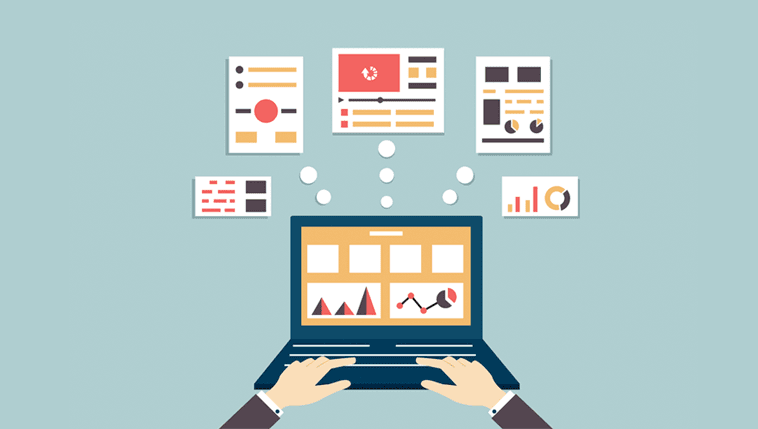
That’s where the Customer Data Platform comes in. A CDP lets businesses collect, analyze, and understand all data points from any source to build a clear overview of their customers.
It makes it possible to gather everything a company knows about a customer across all channels and touchpoints, enabling more relevant communication tailored to individuals and target groups—wherever they are, physically or digitally.
First defined in 2013 by Martech expert David Raab, a CDP is:
“A marketer-managed system that creates a persistent, unified customer database accessible to other systems.”
Since then, the CDP space has exploded in growth and adoption, and it’s now seen as one of the most future-proof technologies in marketing.
Even Forbes highlights the rise of CDPs and how major tech companies like Microsoft, Adobe, and SAP are investing heavily in their own solutions—especially since the pandemic has underscored the value of data and e-commerce.
And it’s not just the tech giants. Thousands of smaller tech companies and startups are also developing their own take on a Customer Data Platform.
The term CDP is becoming more common among marketers, and it’s no surprise. A McKinsey & Co. study shows that data-driven marketing delivers, on average, a 250% higher ROI than traditional, manual methods.
A CDP helps businesses solve a longstanding problem: unifying scattered customer data into one place where it becomes actionable.
This blog post dives deeper into what a CDP is, what it can do, why it’s revolutionary, and how marketing experts and e-commerce professionals can make sense of this rapidly evolving space.
What is a CDP?
Put simply, a Customer Data Platform (CDP) is a database that consolidates usable customer data from various channels and sources. It provides businesses with streamlined access to deep and specific customer insights.
These insights allow for a holistic view of your customers and your business, and having all your data in one place makes that picture clearer and easier to work with.
A CDP serves as a centralized location for all customer data, including identifiers, website visits, purchase orders, email responses, social media comments, customer service interactions, mobile app touchpoints, and any other relevant data.
In essence, a CDP collects, cleans, and merges data from various sources to give you a 360° customer view.
It’s also a strong tool for GDPR compliance. CDPs typically work with first-party data—owned by your company—reducing reliance on third-party data from platforms like Google, Apple, or Facebook.
Once the data is consolidated in the CDP and insights are available, it can be connected to other systems like CRMs. This enables real-time action and decision-making based on those insights.
The average B2C company has customer data from 31 different sources, such as websites, social media, Google, and databases. Each system creates its own segmentation, but limited data means businesses end up with fragmented insights.
This makes it difficult to build a cohesive customer experience, which is expected today.
Segmented data makes it hard to understand how to market your business effectively.
Typically, your data flow might resemble this:
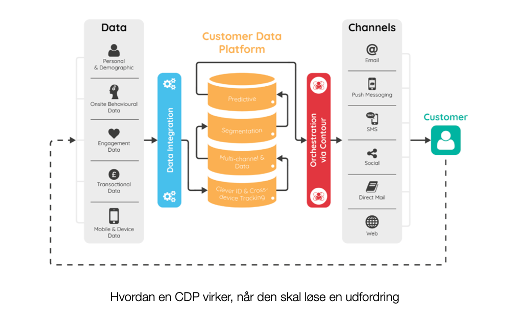
In other words, a CDP is a system that enables businesses to gather everything they know about their customers and users—on and off their own channels—so they can deliver the most relevant communication and customer journey every time, with every customer, on any channel.
Use your data in a smarter way
The average B2C company has customer data from 31 different sources—including their website, social media, Google, and other databases. Each of these systems creates its own segmentation, but since the data is often limited, you usually end up with many different segmentations and inconsistent customer data.
This fragmentation makes it difficult and imprecise, and your insights are not particularly useful for creating a unified customer experience, which is expected from businesses today.
This segmented customer knowledge makes it hard to understand how to market your business and products effectively.
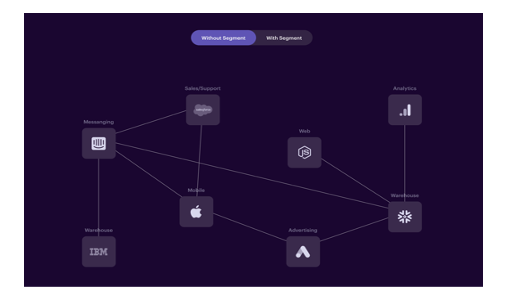
Typically, your data flow will look something like what Segment illustrates.
This flow is further hindered by the need for different software to work together, which requires significant resources to maintain and ensure data flows properly across systems.
We call this the “old method” of data collection. The issues with this method can, in my opinion, be solved by integrating a CDP—what we refer to as the “new method.”
In the new method, a CDP collects all your data from all your sources in one place, giving you a complete overview of your customer data and a clearer picture of their behavior and actions.
A simple explanation of this process can be broken down into four stages.
Data collection
The first stage is collection. Unlike the old method, a CDP can gather all your data from over 180 sources using an API.
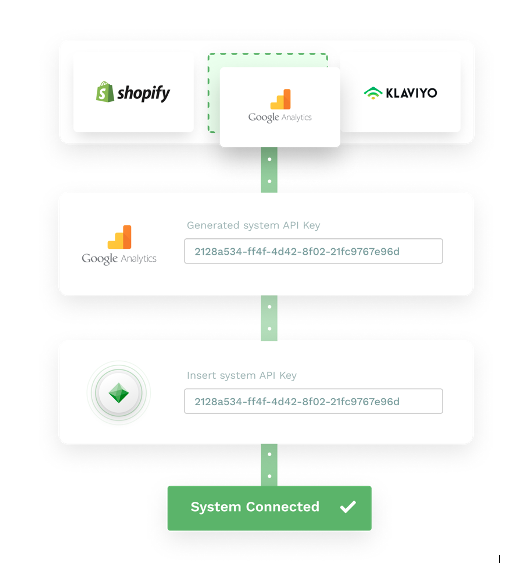
Consolidation
Next is consolidation. Without a CDP, all your systems operate independently and store data in different languages and formats, meaning your Google data might not integrate with your social media data.
A CDP translates all this into a common language, creating a clear and accessible overview of your entire business data—customers, products, and more. A CDP can also draw on external sources like national statistics to validate your data and provide even better customer segmentation.
Analysis
The third and one of the most value-creating stages is data analysis. A CDP uses advanced AI and machine learning algorithms to analyze large data volumes and identify the right customer segments for your specific business and products.
In addition to accurately identifying segments, a CDP can provide valuable customer insights, such as expected profitability of a segment, size, and the likelihood that a customer will purchase a specific product.
An example of such insight might be that the CDP tells you: There are 18,000 mothers aged 30-35 in Vejle with a 37% likelihood of purchasing black trousers, with an expected profit of 279 DKK.
The CDP can feed this data directly into your marketing tools, so you only target the segments that provide the best return on your marketing investment.
Activation
At this stage, you can easily transfer insights and analysis from the collected data to other tools used in your business. A good CDP is built to activate data across tools and channels, allowing you to act quickly on insights.
The CDP enables you to activate your data and serves as a pipeline to other tools, helping your business strengthen customer loyalty, retention, or lifetime value based on CDP data.
An example of this might be in customer service, where the CDP identifies your top customers and prioritizes their inquiries to ensure they receive the best service. Or it might help identify and eliminate bottlenecks in your marketing funnel.
What are the benefits of a CDP?
If you ask me, the benefits of using a CDP are nearly endless, but for clarity, I’ve chosen to highlight six key values that demonstrate what a CDP can do for a business.
360° customer view
A CDP is designed to combine data from various sources and create a unified customer overview. This helps marketers better understand their customers and their behavior.
Marketing transparency
It’s often hard to define the actual costs and ROI of marketing. A CDP solves this by showing exactly how much is spent on each channel and campaign and how each performs. This gives you transparency in your marketing budget and a better understanding of what works—and what doesn’t.
Insights for smarter decisions
By collecting, analyzing, and acting on your customer data, you can make smarter decisions based on real-time data. Your business can respond faster to changes in the market or customer behavior.
Focus on creating improvements
Many marketers spend significant time collecting and understanding their data—sometimes up to 20 hours per month. Automating this process with a CDP frees up time to focus on what truly creates customer value.
Deliver a better customer experience
With a 360° customer view, you can build a complete picture of the customer experience. Today’s customers expect consistent treatment across platforms and channels, and a CDP makes it possible to meet these expectations.
Do I need a CDP?
A CDP can do a lot, but it’s not necessarily the answer to all your challenges—and it might not even fit your business needs if you don’t intend to work with data in this way. That’s why I’ve put together a list of questions to help you evaluate whether a CDP makes sense for you and your business.
- Can you collect all data in various formats (structured, unstructured, semi-structured, relational, binary) to create a clear understanding of each individual customer?
- Do you have multiple channels where you interact with your customers? If so, do you have a system that combines data from those channels and systems, both offline and online?
- Are third-party anonymous data included in your data strategy?
- Can you easily clean, transform, and standardize your data?
- Can you identify customer identities and respect privacy regulations while creating a strong customer experience?
- Can you deliver a consistent customer experience across all channels?
- Can you segment and analyze your customers in real time to create personalized experiences immediately?
- Can you generate universal customer profiles and make them quickly and easily accessible to your analytics tools?
- Can you create look-alike audiences to identify new customers likely to buy, or spot those about to churn?
- Can you act instantly on insights by making data available to other systems?
If your answer is no to even one of these and it’s relevant to your business, then a CDP might be something worth considering, as it can help solve many of these challenges.
How can a CDP be used in your business?
Sure, it sounds exciting to get a system that makes working with data easier, but software only does what you’ve planned for it to do. You don’t buy a sports car just to run errands. Here are a few ideas on what your business can do with a CDP:
1# Understand your customers better
Identify customers who are close to churning so you don’t lose valuable ones. It’s estimated that it costs five times more to acquire new customers than to retain existing ones. Be consistent and don’t miss your chance to engage with customers when they interact with your brand.
2# Identify your most valuable customers
Figure out which customers are the most profitable, buy the most often, engage most with your brand, and return the fewest products. Many e-commerce companies still lack access to the full potential of customer segmentation.
#3 Optimize your best products and reduce underperforming ones
Identify which products and categories are frequently repurchased or recommended, and reduce investment in low-performing products with high return rates. Don’t waste marketing resources on promoting products that leave customers with a bad experience.
The CDP checklist
Understanding what defines a CDP and how the technology works can be difficult. You can use this checklist to ensure your current or future CDP provider meets the necessary criteria and aligns with your company’s needs.
- Collect data from any source
A CDP should ingest all data—behavioral event-level data (websites, apps, mobile browsers), demographic and firmographic data, transaction data, offline and modeled data (e.g., RFM models, propensity scores, next best action). - Retain all input data details
A CDP must store all input data without losing details, including purchase transactions, promotion history, web browsing logs, and changes to personal data. Input data can be reformatted but must be reconstructible if needed. - Store collected data indefinitely (within privacy guidelines)
The CDP must store all collected data as long as permitted, with metadata indicating where the data came from, allowing it to be deleted upon customer request. - Create unified customer profiles
The CDP must match identifiers from different platforms and devices in real time to enable person-based targeting, personalization, and measurement. It should use deterministic and probabilistic matching to build persistent, universal customer profiles. - Share data with any necessary system
A CDP should integrate with any external system via connectors and APIs. It must provide access to deep data insights and enhance customer engagement across tools.
Why should you invest in a CDP?
Customer journeys are not linear and change constantly. When your data is scattered across different systems, it’s hard to keep up or extract meaningful insights. This is where a CDP becomes critical.
A CDP allows you to understand your customers on a 1:1 basis by consolidating data across channels, giving you a complete picture of their journeys and behavior.
Today’s customers expect you to know them like a barber or local shopkeeper would. That level of insight into customer behavior and preferences is made possible through a CDP.
When you have data on your customers, you also understand how to increase their loyalty by delivering the best possible experience tailored to them.
Real-time data enables businesses to adapt quickly, which was essential during the COVID-19 period when customer behavior changed faster than ever before, and old data became outdated quickly.
A CDP not only helps you understand what works but also eliminates irrelevant communication by letting you deeply know your customers.
While this blog focuses primarily on marketing use, a CDP adds value across your entire organization. It bridges the gap between departments by enabling everyone to view the same dashboards and insights.
The finance team sees how money is spent and performance trends. The product team understands what to scale up or cut back. Customer service gets insights into high-value customers and can act accordingly.
The possibilities are endless, and while I could go on listing benefits, the core advantage is this: you save time, money, and resources. Instead of wrestling with your data, your business can focus on growth, and the CDP takes care of the data processing.
Previously, such technology was reserved for enterprise giants, but CDPs are now available to small and medium businesses as well.
CDPs aren’t always easy to integrate and often require data knowledge, but even users without a strong data background can benefit.
At Custimy.io, where I work, we’ve created one of the only no-code CDPs. It takes just 15 minutes to onboard. No developers needed, no advanced data skills required.
Which CDP is right for me?
With everything said, CDPs are clearly an exciting opportunity for any business aiming to improve customer experience and optimize operations.
They’re changing the way marketing is done, and for marketers looking for a competitive edge, CDPs are a powerful tool.
Many companies now offer CDPs. Most can help your business make better decisions based on data and customer insights, but some providers are stronger than others.
Among the leading CDP providers are Segment, Exponea, BlueConic, Mparticle, and SalesManago.
I won’t tell you which provider is best for you—it depends on your business size, industry, and specific needs.
That said, I want to highlight Custimy.io as one of the only CDPs specifically tailored for e-commerce businesses.
I co-founded Custimy.io with a background as an e-commerce manager and CMO. Our goal was to build a product that solves everyday problems for e-commerce managers—so they can focus on growth and creativity rather than struggling with data.
CDP for e-commerce
In this final section, I’ll focus on how CDPs can be a game-changer for e-commerce success and how they help future-proof your competitive edge through smarter data usage.
A CDP helps e-commerce companies transform customer behavior into personalized experiences. It enables smarter decisions across all customer touchpoints.
It helps promote the right products to the right customer at the right time. For instance, send personalized emails to shoppers who abandoned their cart—just like Zalando or Amazon do.
Custimy’s CDP relies only on first-party data, meaning it doesn’t act until a customer has purchased through your store. With that consent, the CDP improves customer experience.
It can analyze preferred colors, communication channels, and ideal times to contact the customer. For example, if a customer buys a specific brand of hair wax, the CDP can help you target them with a Tuesday morning email at 9:30, which may lead to better results—even if Føtex sells it cheaper.
So how do smaller e-commerce companies compete with the giants?
You don’t need the same resources as Zalando or Boozt to win. What you need is deep customer understanding and the ability to act on it.
Most companies can’t compete on price or selection alone. That’s why customer insight is critical—to deliver the best service, recommendations, and marketing.
As a smaller business, you can’t afford to miss. With a CDP, you gain smarter tools to outmaneuver larger competitors.
I’m strongly against wasting 20 hours a month trying to make sense of data when tools exist to automate that process.
Instead, spend your time building campaigns, improving marketing, or innovating. Let the CDP handle the heavy lifting.
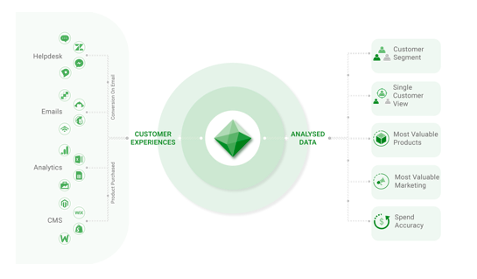
As mentioned, Custimy.io is a CDP built for smaller e-commerce companies that usually wouldn’t have access to this technology.
We handle the complexity, and our platform helps managers who lack time or technical skills to execute on data insights effectively.
Our CDP is built around 1:1 customer understanding. From those insights, we create segments so you can get an overview of your customers and their buying behavior.
It also quickly identifies the best and most relevant marketing for each customer. It’s easy to see which products work and which don’t.
A CDP like ours can tell you who your best customers are—those who spend the most and are likely to return. We call them Most Valuable Customers.
Custimy’s CDP can calculate customer value and use machine learning to identify similar people to target. It’s not about the cheapest customers—it’s about the best ones.
A well-developed CDP keeps evolving. With AI and machine learning, our platform learns from user behavior and provides recommendations based on the most successful marketers using it.
We call this the Power of 100 Marketers. It means our platform brings the best decisions from the smartest users right to you.
Why choose Custimy.io as a CDP platform?
As a conclusion to this blog post, here are my five best reasons why it absolutely makes sense to get a system like Custimy’s CDP if you own a webshop, work in e-commerce, marketing, or just want to strengthen your company’s competitiveness in today’s digital age.
We are no code
As one of the few on the market, you can use Custimy’s Customer Data Platform without needing to be an expert in either data analysis or programming. The platform can be integrated in 15 minutes, allowing e-commerce managers to use all the valuable insights to focus on what they do best.
Built for small and medium-sized businesses
Custimy’s CDP is one of the most accessible CDPs on the market, both in terms of price and user friendliness. It requires fewer resources to access the same tools and data insights that large companies have huge departments dedicated to handling.
You own your own data
You don’t need to rely on Facebook, Google, or Apple when it comes to data. All data collected by Custimy is owned by you. This makes it safer and more future-proof, especially with changes like the new iOS 14.5 update that everyone is talking about today.
Based on first-party data
With all the new GDPR and data security regulations, it is a huge advantage to ensure compliance today and in the future.
With first-party data, your business is guaranteed not to breach data security, while still having full access to an overview of your customers. Custimy’s CDP can pull data from many sources to create a complete picture of your customers and company.
Made to activate and execute
As I mentioned, I come from a marketing background, so it has been crucial for us that the data and insights you get through our CDP are relevant and accessible so you can quickly execute and activate them. Ultimately, it is about using your insights in the best possible way to create results.
I hope this post has shed some light on this new system, clarified the CDP landscape, and helped your company consider something that I dare predict will change how we do business today.




Comments