





The digital world is constantly evolving, and the same goes for the marketing industry. It always feels like it’s moving at full speed, and keeping up with the latest trends and technologies can be a real challenge.
Having spent most of my adult life in this industry, I’ve seen a lot.
Still, new technologies continue to emerge that make me stop and take notice.
I remember being a bit stunned when the story format was introduced, then again when Facebook launched “pixels” and Google introduced the Shopping format.
And now it’s ChatGPT that everyone is talking about.
Artificial intelligence and machine learning have been buzzwords in the digital space for years.
But in my opinion, it takes a mainstream product that’s simple enough for everyone to use before it can achieve widespread adoption.
That’s exactly what I believe ChatGPT has achieved – thanks in no small part to massive hype.
What is ChatGPT?
ChatGPT is a large AI language model trained by OpenAI. It’s a computer-based system (don’t ask me how) designed to understand language (including Danish!) and respond to a wide range of questions and topics.
ChatGPT uses deep learning techniques and is trained on massive amounts of data. This allows it to give accurate answers, translate text, and help research various topics with impressive precision.
In my view, ChatGPT isn’t revolutionary in terms of the underlying technology, but the system itself is because it’s so accessible.
It’s no longer just for the skilled programmers.
It’s also relatively easy to integrate with tools like Google Sheets, which can serve as high-octane fuel for your marketing engine.
There’s been plenty of doom-and-gloom talk about ChatGPT spelling the end for various industries, but I prefer to stay optimistic and focus on how it can be used for marketing—practically and effectively.
I’m constantly learning more about how to use it, and I recently released a course video on the topic.
Let’s dive in! 🙂
ChatGPT & copywriting – research and idea generation
As shown in my course video, you can actually use ChatGPT to generate headline ideas for blog posts and more.
Copywriting, to me, is almost an art form—captivating people through text and letting your unique identity shine through the content.
Of course, ChatGPT can’t replicate that personal touch; it tends to write in a more factual and general way—but it does so better than any tool I’ve seen before.
Let’s get into the fun stuff. Below are a few copywriting prompts you can try:
- Give me 10 headlines about [blog topic]
- Write a body paragraph about [blog topic]
- List 10 positive arguments for using [our marketing tool, e.g. Zapier]
- What are the most common mistakes copywriters make?
- How can I incorporate emotion into my writing?
- List different copywriting frameworks
- Write a humorous headline about [blog topic]
- “Is this text written correctly?” [Insert text]
You can also ask if your text is spelled correctly. I’m still a bit skeptical, but it seems to work.
Email marketing
As mentioned earlier, ChatGPT tends to write very generally about email marketing. Still, it can provide great ideas.
You can also challenge it by asking more specific or in-depth questions—for example, by requesting references to specific email platforms.
I still wouldn’t rely on it for full-on SEO content writing.You can use fragments and rewrite them into your own voice, but since ChatGPT is an AI algorithm, there’s a chance it might generate similar answers multiple times, leading to duplicate content—even if ChatGPT insists otherwise 🙂
ChatGPT & SEO – title tags and meta descriptions
SEO is still very much relevant and has been for what feels like forever. I started working with SEO back in 2009, and a lot has changed since then. Many of the manipulative strategies have been phased out—at least partially—but could they return with ChatGPT?
I choose to stay optimistic. I’ve already used it for SEO myself to brainstorm ideas for title tags and meta descriptions.
Here are a few of my go-to prompts:
- Give me 10 keywords related to ChatGPT and marketing
- Generate 10 title tag ideas for [topic]
- List 10 synonyms for [keyword]
- Research the best anchor texts for [keyword]
- Which keyword is easier to rank for on Google—ChatGPT or Facebook ads?
ChatGPT & coding – snippets and HTML tags
Do you forget your HTML codes sometimes? I do, especially when writing blog posts or working in Google Tag Manager. Instead of Googling every time, I now ask ChatGPT to write the right code for me.
Here are some prompts I use:
- How do I create bullet points in HTML?
- How do I set up a WordPress database?
- Complete my code for a Facebook purchase event (I use this often)
- How do I insert Google Tag Manager into my site code?
- How do I create a div with a green button, centered text, and 100% width? (my favorite—I love CSS)
ChatGPT & social media – inspiration
Like with copywriting, I believe overusing ChatGPT can take the soul out of a brand if there’s not enough human filter applied.
However, ChatGPT can offer strong content ideas for your social posts.
Some example prompts:
- When is the best time to post on Facebook in Denmark?
- What are the optimal image sizes for Facebook posts?
- How long can Instagram Reels videos be?
- Write 10 fun captions about [product] for Facebook
- Write a 200-word emotional Facebook post about a printer (yes, it works!)
ChatGPT & quirky questions
There are so many fun questions you can ask ChatGPT—many of which go viral. It’s reminiscent of the early Google or Siri days.
What’s wild is that ChatGPT’s answers often make sense.
Here are some fun examples:
- Do you have emotions?
- Write a poem about my cat
- What’s in my fridge? (You can have ChatGPT make a recipe based on what you’ve got)
ChatGPT – flaws and the future?
This post is just a surface-level look at the many possibilities with ChatGPT.
It’s important to remember that the system is still in its infancy—but its popularity is already pushing the entire AI field forward.
Investors are interested, and the general public is becoming increasingly aware of its potential. The list of opportunities is long.
Some believe ChatGPT could become Google’s biggest rival—especially if Microsoft integrates it into Bing.
I have my doubts. I think it’s naive to believe Google and other tech giants aren’t racing to develop similar tools.
Alternatives to ChatGPT
To underscore my point, here are a few rising alternatives—fueled by ChatGPT’s popularity:
ChatGPT – limitations
ChatGPT can still make mistakes—typos, mixed languages, or grammatically odd sentences. It’s far from perfect, but it has come a long way in a short time. In January, ChatGPT surpassed 100 million users and became the fastest-growing application in history.
ChatGPT – my hopes
I hope ChatGPT and AI will be used constructively.
I’ve had people ask if they can use ChatGPT to write their blog posts—as if they’re trying to take shortcuts. That’s just how people are. There will always be those looking for an easy way out. My advice: don’t be one of them.
Why should anyone read your content, follow your brand, or share your posts if it’s all something anyone can find in ChatGPT?
It’s important to create original and engaging content that stands out and offers value.
Use AI and technology as tools. Don’t let them use you.
I also hope ChatGPT becomes even easier to integrate into Sheets so it can calculate formulas without me needing to know them (math isn’t my strength). And I hope it helps struggling students learn, and brings people closer across language and cultural barriers.
Since writing this, both Google and Microsoft have launched AI into their core products:
- Microsoft Co-Pilot – integrated across the Office suite
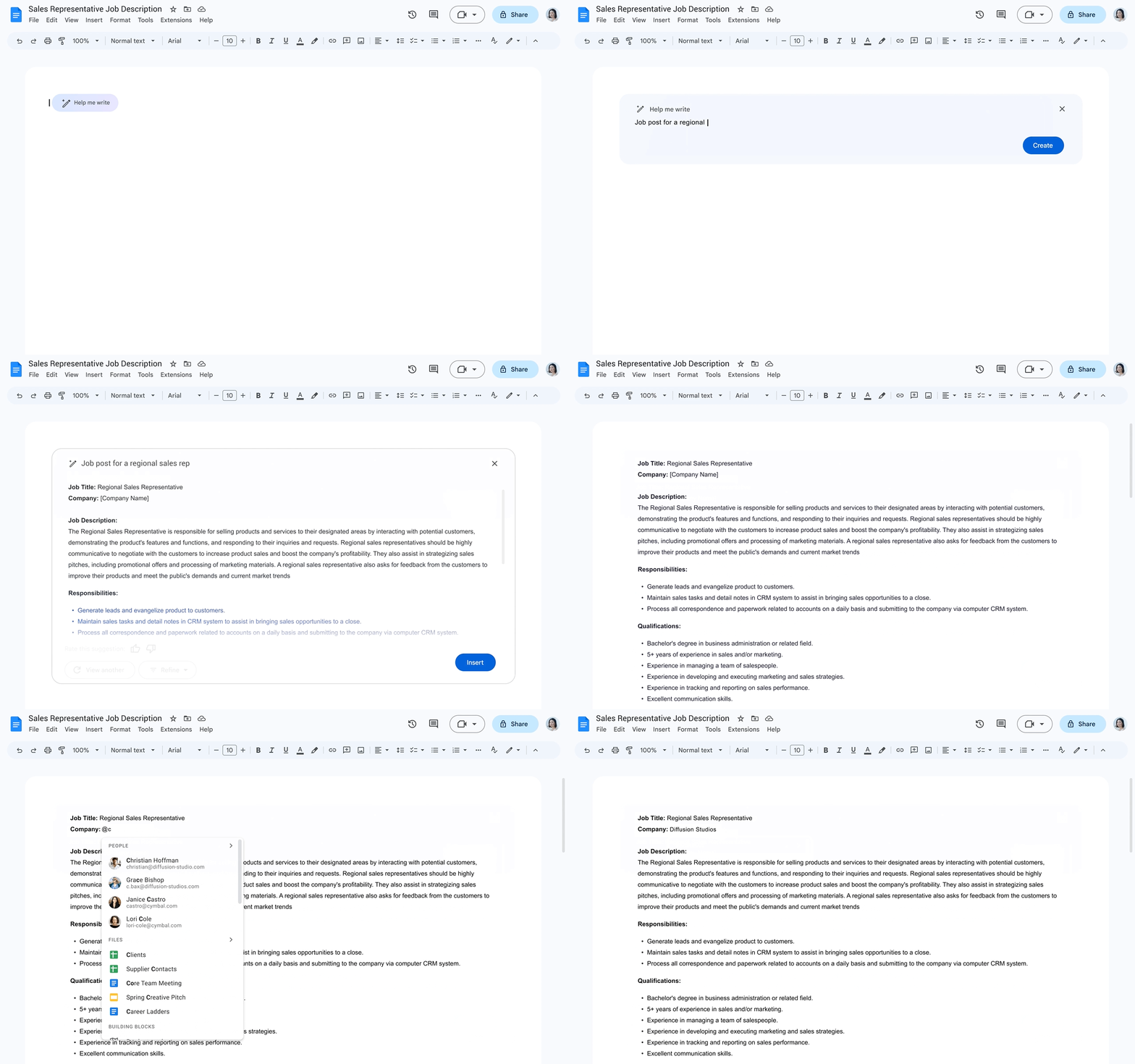
- Google AI – first integrated into Docs & Gmail
Have you tried ChatGPT yet, or do you have any cool tips, tricks, or prompts to share?
I’d love to hear your experiences and ideas in the comments below.
I hope this article has given you a bit of insight, maybe even some inspiration for your own business—let’s explore the many possibilities that AI has to offer together.
Below you can see a presentation of Google’s AI directly integrated into Google Docs.
Have you tried ChatGPT yet, or do you have any cool tips, tricks, or prompts to share?
I’d love to hear your experiences and ideas in the comments below.
I hope this article has given you a bit of insight, maybe even some inspiration for your own business—let’s explore the many possibilities that AI has to offer together.









Comments