

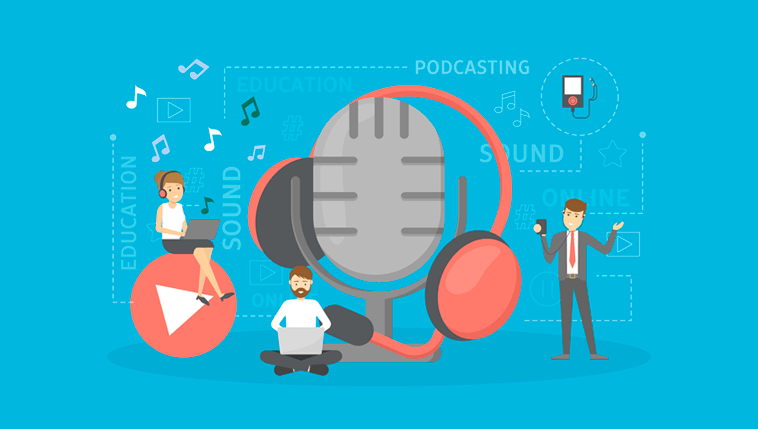



Podcasting has become a medium that has truly taken off in the last couple of years, especially in the marketing space.
I’ve been listening to podcasts a lot over the past few years and I’ve also appeared on a few podcasts myself, although it is still quite new for me.
That’s why I thought it was about time to dive deeper into the subject, and as always, I like to team up with people who know more than I do.
In the podcasting space, I have always been a big fan of Jakob Sloth Linneberg and I’ve also had the chance to see him work up close while recording podcasts.
Jakob is a true podcast nerd – and I mean that in the most positive sense, as I always do when I use the word nerd.
That’s why I’ve handed things over to Jakob today who has put together more than 4,500 words in what we call the ultimate guide.
So welcome Jakob – and thank you for letting me lure you away from your favorite medium and into an article.
Ugli Fruit Productions produces high-quality podcasts and helps others launch and grow their own podcasts.
Jakob Sloth Linneberg – Passionate podcaster. Ugli Fruit Productions

Welcome Jakob!
Thank you so much, Micky, and thanks for having me. Let me start with the basics so everyone can follow along. More and more companies are choosing to use podcasts as part of their marketing strategy. Why it’s a good idea, I’ll explain in this blog – and I’ll also give you a guide on how to easily get started.
The history behind podcasting
Podcasting as we know it today dates back to 2004, when former MTV host Adam Curry and developer Dave Winer made it possible to download online radio broadcasts from the internet to Apple’s then-revolutionary iPod.
Later that year, the first podcast service, LibSyn, appeared. “Podcast” was named Word of the Year in the U.S. in 2005, and by 2009, 43% of Americans had heard of the medium.
However, in the podcast world, people often talk about what happened before and after the watershed year of 2014. That was when a journalist from the radio program This American Life chose to reopen an unsolved 1999 murder case in the podcast Serial.
We can safely call that the “mainstream breakthrough” for the podcast medium, and in the following years the monthly number of podcast listeners in the U.S. doubled from around 39 million to 90 million.
Since then, the medium has exploded and is no longer seen as a niche channel. Today, it is widely considered a new mainstream medium in a world where streaming is taking over traditional media like traditional broadcast TV and radio, both of which are in decline.
Before we get started
… let me tell you which companies should have a podcast. The short answer in my eyes: EVERYONE! But there’s a crucial caveat: if you view your podcast purely as an advertising and sales channel for your business, you’ll quickly find listeners tuning out, and all your hard work will be wasted.
If, on the other hand, you put your (future) listeners, customers, and followers first, focusing instead on “What value can I offer them through my podcast?” – then you are on exactly the right track and should start your own show.
The really good reasons why your company should podcast
Podcasting is something people consume while going about their everyday lives.
In 2019, Danes were asked when they listen to podcasts: 58% said at home and 81% while commuting – whether by bike, car, or public transport.
This is one of the medium’s greatest strengths and explains why you can hold listeners’ attention for longer periods.
Your listeners stay with you (almost) all the way
In 2020, U.S. media research firm Edison Research published its annual The Infinite Dial report, showing that 80% listen to most or all of an episode. With the average podcast lasting 41 minutes and 31 seconds (source: Dan Misener, Pacific Content), that means 4 out of 5 people listen to at least 31 minutes.
This aligns with my own data and statistics from my podcasts.
The advantage? You get to spend quality time with your listeners and dive deeper into your passion – something that’s difficult to achieve in short videos or posts on LinkedIn, Facebook, Instagram, and other platforms.
Of course, holding their attention isn’t automatic. Competition for listeners is fierce, and success requires mastery of storytelling, communication, and, not least, the hosting role.
You build trust in yourself and your company
Unlike blogs and videos, podcasts don’t just position you as an expert – they build trust and a personal connection with your listeners. Humans naturally respond to voices and emotion, making podcasting one of the most powerful and authentic ways to communicate.
The stronger the personal connection listeners develop with you and your company, the greater the chance they will buy from you – or recommend you to others.
You can repurpose your content
Your podcast shouldn’t stand alone. It should be an integrated part of your content marketing strategy.
For example:
- Repurpose your podcast into YouTube content. Don’t just upload audio with a static image – film the recording from multiple angles, choose a nice setting, and spend time editing to make it engaging. A great example: The Joe Rogan Experience.
- Transcribe your episodes or turn them into blog posts. This boosts SEO and provides value to those who prefer reading.
- Use your 10–20 key takeaways from each episode for social media content – either short video clips or by using tools like Headliner app to create visual snippets.
Expand your network and attract the right clients
Podcasting is especially effective for small businesses as a way to connect with industry experts and potential partners. Invite them as guests. Even if you don’t yet have a large audience, most will gladly say yes because it offers exposure.
This gives you a unique chance to build strong personal relationships – often through casual conversations before and after recording, where you can make a positive impression.
Tell good stories and increase brand trust
Why not use podcasting to explain complex topics, like how your company contributes to the green transition?
A study by Teknologisk Institut (June 2020) showed that 20% of Danish companies actively work with the UN’s 17 Global Goals. Your podcast is a great place to share these stories – and loyal listeners will love them.
Younger audiences especially love podcasts
According to DR’s 2020 Media Development Report, the share of Danes listening to podcasts weekly rose from 9% to 26% since 2016. Among young people (15–31), the figure is 44% in 2020 compared to 25% in 2017.
If your product or service targets this group, podcasting should absolutely be part of your sales, branding, and marketing strategy.
How to create your own unique podcast
Believe me, once you get started, producing and publishing a podcast is actually much simpler than most people think. The most time-consuming work lies in the beginning, where you move from vague ideas to a solid concept, buy the right equipment, learn to edit (unless you outsource this part), and distribute your podcast.
Once this is in place, you are well on your way, and I want to explain how by making the process manageable for you.
Ask your ideal listener
You know your target audience – and therefore your ideal listener – better than I do, and now is the time to do your research. Ask them:
- Which podcasts do you listen to?
- What do they do well?
- What could they do better?
This gives you an impression of what your ideal listener wants and is looking for in a podcast. This is valuable knowledge you can bring into the next part of the process.
Run a structured brainstorming session
Next, sit together as a group and write down all your podcast ideas individually. Divide them into two categories: those that concern the overall concept, and possible topics you can cover in the podcast. Then debate and refine each idea together, finally deciding whether to discard it or keep it. During this process, it is not unlikely that new ideas will arise, giving you a stronger and more solid concept.
Efforts to debate each idea have, in thorough studies from 2004 (source: University of California), proven to be more effective than the uncritical brainstorms that are usually used. In general, debate and critique are good for idea development and activate the brain.
The reason I recommend you identify the first 10 topics for your podcast already during the idea phase is that it provides the necessary overview and direction, enabling you to start production faster.
Questions that can help during idea and concept development
- Why do you want to podcast?
- What should the podcast be about?
- What is your goal with the podcast?
- What is your ideal listener looking for in a podcast?
- What do your competitors do well?
- What could they do better?
- What should the length of each episode be?
- What feeling should listeners be left with after listening?
- What should the tone and language of the podcast be? (formal/informal?)
- Which podcasts would you consider competitors, and can you differentiate yourself from them?
- How often will you publish? (and be realistic about the time you can commit)
The three most common formats
Within business podcasts, three formats are particularly common: solo, interview, and co-hosted podcasts.
A solo podcast is hosted by one person. It is especially suitable for solo entrepreneurs who want to speak and publish blogs and articles that followers can take with them on the go. The advantage is that it is easy to start and maintain, but the clear disadvantage is the lack of dynamic interaction between two or more people. In general, podcasts with a guest or multiple hosts perform better than solo podcasts.
The interview podcast is characterized by inviting a guest into the studio for a conversation about a specific and relevant topic with one or more hosts. This is particularly suitable for companies that want to use the podcast to establish new and strong relationships with experts and market leaders in the same industry. The drawback is that it is more time-consuming to produce. It takes time to secure agreements with guests, plan interviews, and travel to and from them (unless you record online or the guest is willing to visit you).
The co-hosted podcast is characterized by several hosts sitting “around the table.” Typically, the same hosts return for each episode, while the topic changes each time. The advantage is that it is easy to get started, and you can record multiple episodes in one day. The disadvantage is that you miss the clear benefits of inviting a guest.
What makes a good concept?
You have researched, brainstormed, and chosen the right format. Now you need to make the concept simple, clear, and easy to understand. This is important because listeners want to know right away what the podcast is about and what they will gain from listening.
Here are examples:
- “Behavior is a podcast about creating change. It’s about why people do what they do and how we can change them” – Behavior with Morten Münster
- “In Marketing Brief, you get specific tips, tricks, and hacks for your online marketing activities.” – Marketing Brief with Halfdan Timm and Emil Kristensen
- “Sagt mellem os is the podcast where I challenge the unprepared but enthusiastic panel with a series of current management discussions and dilemmas submitted by listeners out there.” – My own podcast; Sagt Mellem Os..
It is not only for the listeners’ sake that you should make the concept simple and digestible. You should also make your podcast easy to produce and edit. Otherwise, there is a high chance it will end like half of all podcasts, which stop before reaching 14 episodes: they end up podfading (source: Pacific Content).
Podfading means you suddenly and without warning stop producing new episodes. There is not even a final episode where you say goodbye to listeners. Most likely, you simply run out of energy, capacity, and motivation to continue.
How to avoid podfading
- Schedule a fixed day each month for recording and preferably record several episodes at once.
- Avoid setting up and packing down equipment every time. If possible, leave it standing in a meeting room, making it much faster and easier to record next time.
- Have realistic expectations for how often you can publish. Start with 1–2 episodes per month and increase later if possible.
- Consider outsourcing editing, which most people find boring. Many podcasters hire student assistants for this part, as they are often more affordable than professionals.
What does it cost to get started?
If you have ever attended a sales meeting with someone from Northern Jutland like me, the most important item on the agenda has surely been “What does it cost?”
Before I answer, let me be clear: the sound quality of your podcast MUST be good. You need to invest in proper equipment, because the podcast is the sound of you and your product or services. If you promote yourself as delivering quality, poor sound cannot tell a different story.
The good news is that quality sound no longer costs a fortune.
Assuming you need equipment for two people, here are three different setups that ensure professional sound from the start:
- Good sound: 2 x Rode Podmics + Zoom H4N Pro recorder: approx. 3,400 DKK incl. VAT
- Fantastic sound: 2 x Rode Procasters + Zoom H6: approx. 5,190 DKK incl. VAT
- Creme de la creme: 2 x Shure SM7B (the microphones Michael Jackson used to record Thriller) + Rode Rodecaster Pro: approx. 10,000 DKK incl. VAT
Additionally, for each setup you need two XLR cables (30–100 DKK) + a pair of microphone stands (90–200 DKK) or arms (approx. 500–600 DKK).
Admittedly, you may be able to find other equipment that is possibly better (and maybe even cheaper), but the above is gear I have personally used and can vouch for.
An excellent (and free) editing program
It is up to you whether your company has the resources to outsource editing. It is often the part most people find boring and uninspiring. The good news is that there is a good editing program you can download completely free. It is called Audacity, and on YouTube you will find several great guides on how to get started.

Storytelling is crucial
Can you use storytelling in a business podcast? Yes, absolutely! You cannot and should not compare it with how true crime podcasts use storytelling to create suspense and cliffhangers. There are other ways you can do it, and the opening of the episode is crucial. This is where you must capture the listeners.
What works especially well is setting the scene and describing the surroundings right from the start: “Thank you so much (guest) for letting us come to your summer house and talk with you about (topic). And let me just say from the beginning that the view here from the terrace is mind-blowing. We are sitting with the most beautiful view of the Kattegat, the water is completely calm, the sun is shining, and there is a cold Grimbergen on tap…” If you start by describing the environment, the listeners begin to start visualizing the scene themselves. They imagine themselves sitting in these surroundings, and it is incredibly powerful.
Also consider opening the episode with a story from your own daily life that describes why you chose the topic: “I remember when we founded the company almost 10 years ago. We all believed that orders would pour in from the start, but they simply did not. And we could not understand it! The goods were in stock, ready to be shipped, and we used everything we had learned about marketing to reach potential customers. But nothing happened! It was frustrating, and many days we felt helpless. Then I remember my former boss recommended that we use (insert solution), and it was decisive. I remember clearly when the first order came in. It was magical to hear the little bling, and we all burst out cheering! Soon the next order came… and the next… and the next… I will never forget it.” These are the stories listeners remember, because they can relate to the same feeling of success or have felt the same frustration. It is more powerful to describe emotions and tell a story than to describe a problem and solution in an academic and technical way.
Another simple trick is to tell listeners what questions will be answered along the way, and especially to save the best for last: “… and if you listen to the end, you will get the answer to what was crucial for our growth + 5 simple tips and tricks for how to achieve success with (…).”
Storytelling is crucial, but also make sure to give listeners something concrete they can work with. A combination of the above ensures that they will follow your podcast and not the others on the market.
“What did an annoying man in a supermarket teach Daniel about happiness?”
A really good and simple example of how to spark curiosity and hold listeners’ attention through an episode is what Morten Münster does. In his podcast Adfærd, he had Daniel Rye as a guest, who was held captive by ISIS for just over a year. In itself, a story that has everything.
In the intro, Morten uses a simple trick and asks the listeners: “What did a really annoying man in the supermarket teach Daniel about joy of life?” – Do not tell me that you are not curious about what this annoying man actually did.
Do not underestimate the importance of a good host
The host plays a huge role in a podcast’s success. The graph below shows that a poor host has a greater influence on whether a listener abandons a podcast than poor sound. It is not just about the sound being good. You must also be good.
You may have followed all the above advice carefully, the knowledge you share may be invaluable, and the concept may be sharply formulated, but if you do not speak passionately about the topic or let your personality shine through, listeners will not form the important connection with you. And if they do not feel your personality and passion, it is far from certain you can keep them engaged.
A good tip is to record several dummy episodes to get comfortable sitting behind the microphone. Listen to each dummy carefully, be critical of yourself, and evaluate whether you communicate your knowledge in an engaging way. You can also ask for feedback from some of your potential listeners and hear what they think.
Of course, there must be room for development and improvement, but the stronger your podcast is from the beginning, the greater the chance that listeners will choose the next episode – and the next after that.
How to get your podcast on Apple Podcast, Spotify, and Google Podcast
For this, you need a hosting service where you can easily store and, via an RSS feed, distribute your episodes to the various podcast platforms. This happens automatically once you have uploaded an episode. In addition to uploading episodes, cover art, and writing show notes, the various services also provide analytics, web players for your website, and scheduling tools.
I personally use Spreaker, as it meets my requirements for usability and stability, and I have never experienced problems with uploading episodes.
Important! Remember to send your podcast for approval on the different platforms. On average, it takes a few hours for Spotify to approve a podcast, while it can take 1–5 days on Apple Podcast. These two platforms in particular are essential for your podcast at launch. You do this easily by recording a short introduction episode, uploading it, and sending it for approval.
Good advice for publishing your podcast
The launch of your podcast is approaching. You have recorded the first episodes, you are ready to enrich your followers with excellent content, and of course you want as many as possible to follow from the start. You can do this by:
- Giving listeners variety by releasing at least three episodes on different topics from the beginning.
- Focusing on getting listeners to subscribe to the podcast. In 2018, the hosting platform Libsyn analyzed hundreds of shows over several weeks and found that the most important ranking factor used by Apple Podcast’s algorithm is the number of subscribers and subscriber growth. For example, my podcast Sagt Mellem Os only had a few hundred plays when it was listed for several weeks under “Top shows” in the Business category.
- Ensuring that your podcast is visible, which is crucial for a good start. Have a solid marketing plan ready. Be aggressive with newsletters, social media, etc., and send personal messages to potential listeners in the hope that they will recommend your podcast to their network.
Just as visibility is crucial, so is patience. I usually tell the companies I work with that when they launch their podcast, they should not expect the same hype as the season premiere of Vild med Dans or X-Factor. Maybe an exaggerated and incomparable example, but no less true. You must accept that you will not get thousands of plays in the first week (unless you are Mads Steffensen), because building a solid listener base takes time.
If you continue to deliver strong content and keep promoting the podcast, you will have a unique show where hundreds (maybe thousands) tune in week after week.
Websites and tools you need to know as a podcaster
- Audiojungle – www.audiojungle.com
On Audiojungle, you can easily find the ideal jingle for your next podcast. Note that if you purchase a Standard License, it must be renewed after more than 10,000 plays. - Fiverr – www.fiverr.com
If you want a unique jingle and/or logo produced, thousands of freelancers offer their help on Fiverr. If you choose to get help designing a logo, remember to have it made in 1400×1400 pixels. - Canva – www.canva.com
You probably already know Canva, but it is my and many other podcasters’ favorite tool for visuals (logo and marketing). - Headliner – www.headliner.app
Headliner will become your favorite tool for marketing your podcast. With this tool, you can highlight important key points from your podcast in a simple and visually appealing way. See, for example, how the podcast Iværksætterhistorier uses Headliner by following them on LinkedIn or Facebook. - Calendly – www.calendly.com
Calendly makes it easy to schedule interviews with your guests. - Auphonic – www.auphonic.com
If you choose to edit your podcast yourself, Auphonic is a an absolute lifesaver. Auphonic uses AI-based audio algorithms to post-produce your episodes. In Danish, this means that once you have edited an episode, you run it through the Auphonic engine, which delivers a high-quality audio file ready for distribution. - Chartable – www.chartable.com
Chartable is an analytics tool that gives you an overview of how your podcast performs across platforms. - Zencastr – www.zencastr.com
If you want to record remotely, Zencastr makes it easy and simple. The only drawback is that you cannot “see” your guest, so I recommend also using Zoom.
Conclusion on the podcast medium: we have only seen the tip of the iceberg
There is still enormous untapped potential in the podcast medium. True, 26% of Danes listen to podcasts weekly, a tripling since 2016, but we have only seen the tip of the iceberg.
There are still about 50% of Danes who do not know how to listen to a podcast, and only now are we truly integrating the medium into sales, branding, and marketing.The space is only going to keep growing.
We also see major players like Spotify, Apple, and soon Amazon investing heavily in audio, and Denmark’s public broadcaster Danmarks Radio is also heavily investing in the medium, recently achieving great success with the news podcast Genstart.
It is not only the major players who see the potential in audio. More and more companies, large and small, are starting their own podcasts to market and communicate with customers and followers. I look forward to seeing the creative ways the medium will be used.
I hope my guide has given you the incentive and the necessary push to get started, because it will not be long before your competitors have already launched their own successful podcasts.
Podcast FAQ: A Guide to starting and growing a podcast
How do I come up with a podcast concept people actually want to listen to?
The biggest challenge for most new podcasters is not the technical setup, it’s the concept itself.
A lot of people start with a topic they personally find interesting but forget to ask whether their audience actually wants to spend 30–60 minutes listening to it.
The best podcast concepts usually sit at the intersection of something you know deeply and something your audience actively wants inspiration, knowledge, or insight about.
The clearer the value proposition is, the more likely listeners are to come back for future episodes.
It also helps to think beyond individual episodes and focus on the overall format. What’s the common thread? Why should people subscribe instead of just listening once?
How often should I release podcast episodes?
Consistency matters far more than frequency.
A lot of new podcasters start with ambitious weekly schedules and burn out after a few months. In most cases, it’s smarter to start with one or two episodes per month and build from there.
Listeners quickly get used to the rhythm. If you consistently show up, you gradually build a habit around your podcast.
Podcast growth is rarely about moving fast. It’s usually about being the one who keeps going long enough to build momentum.
How long should a podcast episode be?
There’s no perfect podcast episode length.
Some of the best podcasts are 15 minutes long, while others keep listeners engaged for several hours. What matters is not the duration itself, but whether the content stays relevant and engaging throughout the episode.
As a general rule, most business and marketing podcasts perform well in the 30–60-minute range because it allows room for stories, reflections, and actionable insights.
If an episode feels unnecessarily long, though, listeners tend to drop off quickly. It’s usually better to tighten the content than stretch the runtime.
Is it better to start a podcast alone or with a co-host?
That depends entirely on your personality and the type of podcast you want to create.
A solo podcast gives you full control and is much easier to plan and schedule. The downside is that you need enough energy and communication skills to carry an entire episode on your own.
Adding a co-host or guest often creates a more natural and dynamic conversation because spontaneous reactions and discussions happen organically.
For new hosts, interviews or co-hosted formats are often easier than sitting alone behind a microphone from day one.
How do I make my podcast more interesting to listen to?
The best podcasts rarely feel like lectures, they feel like conversations.
A lot of podcasters focus too much on sounding professional and not enough on personality, storytelling, and energy. But the things listeners usually remember are the real experiences, frustrations, lessons, and personal stories.
You don’t need to sound like a traditional radio host. In fact, podcasts often work better when the host sounds natural and human.
Focus less on perfection and more on communication. If listeners feel like you’re talking with them instead of at them, you’re already ahead.
How do I get the first listeners for my podcast?
Most podcasts don’t get a lot of listeners in the beginning and that’s completely normal.
Launching a podcast is not just about publishing episodes. It’s equally about visibility and distribution. Use the channels you already have: LinkedIn, email newsletters, Instagram, YouTube, or wherever your audience already follows you.
It also helps to launch multiple episodes so new listeners have more content to explore. If people only discover a single episode, they’re often less likely to subscribe.
Podcast growth is rarely explosive. It usually happens gradually through consistency and word-of-mouth recommendations.
How do I choose the right podcast equipment?
The goal is not to buy the most expensive setup. The goal is to create audio people actually enjoy listening to.
A lot of beginners overestimate the need for advanced studios and underestimate the importance of clear audio in a quiet environment. A solid microphone and decent sound quality matter far more than expensive cameras or visual effects.
If you’re just getting started, it’s often smarter to keep things simple and learn the format first. You can always upgrade your setup later as podcasting becomes a bigger part of your content strategy.
Bad audio becomes exhausting very quickly. But great audio alone will not save a boring podcast.
Can AI help with podcast production?
AI can save an enormous amount of time in podcast production.
Many creators already use AI for transcription, show notes, content ideas, social media clips, title generation, and episode summaries. It makes it much easier to repurpose podcast content across multiple channels.
That said, AI should never replace the personality of the podcast itself. People don’t just want to listen to information, they want to listen to a dynamic host, great atmosphere, and valuable perspectives.
The best way to use AI is as a production assistant, not as a replacement for authenticity and human communication.
How do businesses make money from podcasts?
Most business podcasts don’t make money directly from sponsorships in the beginning.
However, podcasting can be extremely valuable as a branding and relationship-building channel. Podcasts create trust over time because listeners spend long periods engaging with you and your brand.
For many companies, the real value comes from authority, relationships, leads, and positioning – not necessarily from ad revenue.
A strong podcast can shorten the path to a sale because potential customers already feel like they know and trust you before the first conversation even happens.
How do I know if my podcast is successful?
Success in podcasting is more than just download numbers.
Of course, listeners matter but engagement is often even more important. Are people messaging you about episodes? Sharing your content? Mentioning the podcast during sales calls or client conversations?
Many niche podcasts with relatively small audiences still generate significant business value because they attract the right listeners very precisely.
That’s why success should not only be measured by scale. A podcast with 500 highly relevant listeners can easily be more valuable than one with 10,000 random plays.




Comments