




I’ve had this feeling in my gut lately, a feeling not related to too many pastries, but about having my own webshop or being a partner in a project again.
I am craving a new adventure after my break from consulting, but enough about that for now.
There’s something magical about putting all your energy into one project. I often wish I had the knowledge I have today when I was CMO at Firtal.
This restlessness led me to many ideas and thoughts, primarily about how I would approach things myself and the lessons I have gathered over the last five years.
I also believe we are entering a period where, for example, e-commerce will face much tougher times than the last two years. This makes it the perfect moment to return to the basic strategies.
Generally, when the economy slows down, you need to use every tool in your toolbox – everything becomes more difficult.
Positive warning: This list ended up longer than I initially expected. I have chosen not to include how I would structure a team, as I covered that in my latest post about digital organization.
This is purely marketing, tips and tricks, and the tools I personally use.
To be completely honest: This is one of the best posts I have written in the last ten years, packed with knowledge and free materials you can download. Feel free to leave a comment if you think I missed something or if you need further elaboration.
All of these strategies are more or less easy to implement. My first recommendation is to handpick strategies from the list below that suit your business. Then set them up in an Excel or Google Sheet file.
If you do this, you will have enough tasks for at least the next 12–24 months, and trust me, you will have plenty of aha moments along the way.
You should also divide them by priority and resources.
You can see a real example from my own data sheet for a webshop below.
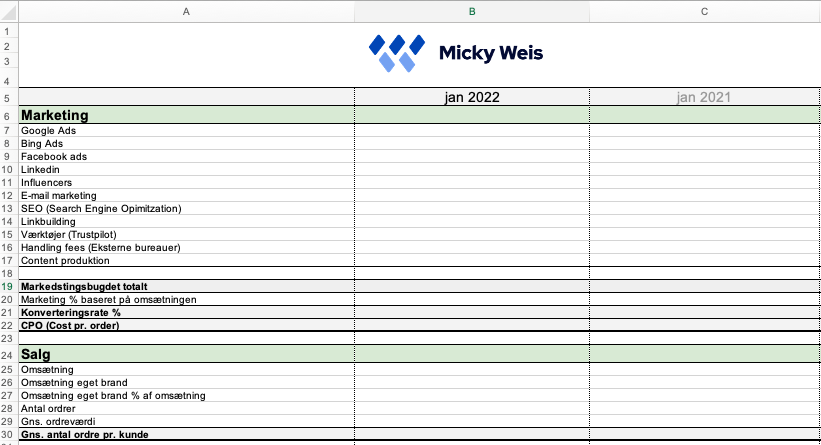
Several of you have asked in previous posts if I would share my full Excel sheet with you, and after some thought, I have decided to make it downloadable. You will need to do the calculations.
This Excel file is based on webshop data, but KPIs can easily be adjusted if, for example, you work with an app, a physical store, or something else. My hope is that you connect additional tools yourself and see what works for your business.
Download my full Excel file of marketing data
Tip: An important note is to make a small reminder for each month. We forget things surprisingly quickly. That’s actually a useful survival mechanism to avoid drowning in information overload, but it is less advantageous when analyzing year-over-year.
Corona is a perfect example. We have already forgotten it, which is why we now wonder why our index is at 50 instead of 200. The 2018 summer heatwave also had a huge impact on online sales, which is why I often include DMI’s weather data in my analyses.
Let’s look at all the concrete strategies, some more familiar than others.
Paid search advertising
Paid ads in search engines probably need no introduction. Yet, many are surprised by how many search engines actually exist. Below I have listed a few, but there are hundreds in total. In Denmark, I would focus on Google and Bing.
- Google ads
- YouTube ads
- Bing ads
- Baidu ads
- Yandex ads
- Spotify ads
- Apple Store ads
Systems for paid advertising I have used or recommend
- Google ads editor – easiest place for bulk ads
- Adstage.io – easy to aggregate data across platforms, also from sheets
- Funnel.io – excellent for automating data
Paid social media advertising
Just like search engines, there are many more social media platforms than we in Denmark typically use. Below is a priority list if your focus is within Europe. Expanding globally brings more platforms, like WeChat in China, but for now we focus on Europe.
- Facebook ads (Owned by Meta)
- Instagram ads (Owned by Meta)
- Snapchat ads
- Tiktok ads
- Pinterest ads
- Twitter ads
- WhatsApp ads (Owned by Meta)
- Reddit ads
- Quora ads
Systems for paid social advertising I have used or recommend
- Profitmetrics.io – Danish system that can include your profit in Facebook ads
- Dashthis – simple reporting system for channel overviews
- Confect.io – optimizes ad appearance
- Facebook ads library – see which ads others are running on Meta platforms
Tip: Paid advertising, both in search and social, can feel overwhelming when you’re new to it. These are large systems. Even after 10+ years in the industry, I can still get confused. Fortunately, many of these systems share the same methodology, so learning one makes others easier. Many quickly realize they need external help. I recommend hiring a freelancer or agency. Some I’ve worked with: ICE Digital (Facebook & SEO), Geniads (Google Ads), Obsidian Digital (Strategy), Mindmill (B2B).
Again: personal fit matters most. Continuous self-education is also crucial for effective collaboration. I even developed my own Facebook & Instagram course, primarily to train employees.
E-mail marketing
People often ask if email marketing is becoming obsolete. My answer: no. It remains one of the best channels for direct revenue. With more emails received, communication must stay interesting.
In the past, sending one email per month sufficed. Now, personalization and automation flows are key.
Automation flows based on behavior
- Welcome email
- Abandoned cart email
- Winback email (after x days of inactivity)
- Thank you for your order email
- Product back in stock
- Product you viewed decreased by x%
Email collection methods
- Pop-ups (Sleeknote)
- Lead generation ads (Facebook & LinkedIn systems)
- Inline downloads such as whitepapers, guides
- Exit pop-ups – use sparingly
Systems for email marketing I have used or recommend
- Klaviyo
- Mailchimp
- ActiveCampaign
- Campaign Monitor
- Zapier (to move emails between systems)
- DKIM & SPF keys (prevent emails from going to spam)
Tip: Email collection is a goldmine, but avoid too many pop-ups, especially alongside cookie pop-ups. Integrated forms in blog posts work well. Always test on mobile devices.
SMS marketing
SMS marketing, like email, remains a top channel for direct sales but requires careful use. It is personal, so overuse can irritate. Consider SMS for promotions, pre-sales, and discounts.
Remember unique discount codes to track performance
- InMobile
- Twilio
- Braze
Tip: Zapier can integrate with MailChimp. In Denmark, InMobile works well. Collect phone numbers via lead ads, allow opt-out to avoid complaints, and check GDPR rules.
Influencer marketing
Influencer marketing is a unique channel that requires finding the right setup for your business. Many fail initially and conclude it doesn’t work. Done right, it works extremely well.
- Discount codes (Voucherify for unique codes)
- Agencies (CUBE, Nogoodagency, Social Works)
- Platforms (Brandheroes, Dreaminfluencers, Makeinfluence, Brandbassador)
- Collaborations (e.g., Mathilde Gøhler for Nordgreen)
Systems I recommend
- Woomio – find influencer data
- Socialblade – track social growth
- Aspire.io – track influencer performance
Tip: Test strategies based on budget and scale. Micro-influencers often drive immediate sales, while top influencers act as celebrities. My full influencer guide provides more insights.
Gamification
Online engagement is huge, yet few use gamification platforms to drive customer interaction.
- Leadfamly (my favorite)
- Scratcher.io
- Dot.vu
- Gametize
Tip: Ensure strong email flows first. Users should feel rewarded. Gamification platforms usually integrate with major email systems. Use Zapier if needed.
Affiliate marketing
Affiliate marketing has been neglected, but it holds huge potential. Webshops can benefit from percentage-based payouts, which also provide indirect branding.
- Partner-ads (E-com DK)
- Awin (international)
- Amazon Associates
- CJ Affiliate
- Firstpromoter (SaaS)
- Rewardful.com
Tip: Some industries are dominated by a few affiliates via Google search. Learn the systems and offer incentives. Commission rates often reach 20%, and cookie durations vary.
Content marketing
Content marketing, or inbound marketing, in my opinion, is one of the best places to start. Content has a major influence on your SEO and, not least, you create material you can use across other channels such as Facebook ads, newsletters, and much more. I divide content marketing into two parts: internal, which you host yourself, and external, which you create on other media.
Internal content marketing
- Blog posts such as the one you are reading here
- Let external partners write content (Sleeknote is good for this)
- Host a podcast – similar to Marketingbrief, though there are many examples
- Whitepapers (PDF files with truly valuable content)
- Video guides – onsite and YouTube
- Webinars – especially if you have complex products
- UGC – User Generated Content
- Online course in your own products
- Organize events
- Interview industry leaders and tap into their audiences
External content marketing
- Guest posts at other media
- Participate in podcasts
- Lectures
Systems for content marketing I have used or recommend
- Twentythree (webinar platform I prefer)
- Podcast production
- Loom.io for video guides
- Simplero for course setup.
- Fiverr (endless options, I use it for example for voiceovers)
- Facebook ads library
Tip: Convert one piece of content into another. For example, turn a blog post into an infographic or a video into a blog post. You can also record videos without sound and buy inexpensive voiceovers from Fiverr for Swedish, Norwegian, Finnish, etc. Remember that content marketing, like SEO (and many other strategies for that matter), takes time. It may take one or several years before you reap the rewards. In the long run, though, it is one of the best strategies in my opinion. As I described in the introduction, content marketing also provides material for all other channels, which is a huge strength.
SEO – søgemaskineoptimering
Search engine optimization, also known as SEO, has for many years been a key channel to drive traffic. Competition, however, has become fierce and Google has become much better at spotting attempts at manipulation. There are countless SEO tools available. They vary greatly in price, so find the one that fits your level.
- Link building (a highly debated area, but still relevant)
- Technical audit – hire external assistance
- Keyword analysis – hire external assistance
- Rich Snippets in Google search results (extended search information)
Systems for SEO I have used or recommend
- Morningscore – Danish system that covers most areas of SEO, easy to set up
- Ahrefs – large system, requires some experience, one of the world’s leading SEO tools
- Google Keyword Planner – free, helps you check search volume in a market
- Searchmetrics – if you have the budget it can do a lot, but quite expensive
- Screaming Frog – technical tool for analyzing site issues
- Google Search Console – free, provides more technical insights than Google Analytics
Tip: SEO takes time, not least because of the fierce competition. It often requires external assistance, as there is a lot of room for mistakes. SEO is also a complex area, as it quickly becomes technical. A good SEO partner is invaluable. Do not, however, expect to become number one immediately. If you do, you have unrealistic expectations, and in the worst case, manipulative tactics may get you removed from search results. Slow and steady progress wins the race.
Customer service
Customer support is the key to running a good online business, whether you are in B2B or B2C. In my opinion, there is also a huge benefit in including customer service in overall development, so that all the knowledge you gain from end users is passed on to product and marketing teams.
- Customer scoring. Find a system that can score customers and help you optimize support through data.
- Live chat. If you have the capacity. Especially useful if you have a complex product.
- Are we available when our customers are? If your customers mainly shop in the evenings, offer support then.
- Trustpilot. There is no way around it, be active and respond quickly to negative experiences.
- Social media. You cannot avoid them, most can be integrated into a customer service system.
- Google My Business. Often the first thing a potential customer sees when they Google your brand. Keep opening hours updated and respond to questions. If possible, integrate this into your customer service system.
Systems for customer service I have used or recommend
Customer service systems are almost a religion. I have tried many, so I chose three. Pick one and become good at it. They cost money, but this is one of the most important areas in any business.
- Dixa – Danish startup, newer system, surprisingly good
- Zendesk – one of the world’s biggest, with countless integrations
- Freshdesk – similar to Zendesk, pleasant interface
Live Shopping
Live shopping is growing massively, so I think it deserves its own section, even if the strategy is fairly self-explanatory. We currently see it with “yes please” offers in comment sections.
- Sprii – by far the best system I have experienced for this. It doesn’t need much elaboration, but I believe this will become bigger and bigger in the future.
Internationalization
When you live in a small country like Denmark, where we are quite similar in behavior and especially in trends, it’s easy to fall asleep and think you have everything under control. Internationalization has changed that. Now you are competing with the whole world.
At the same time, it gives you the opportunity to build a business beyond borders.
That’s why it is crucial to be ahead of consumer behavior in other countries. For example, in Germany there are huge differences between cities, and they prefer to shop on Amazon. In Sweden, Klarna is the preferred payment option, while in the Netherlands it’s iDeal.
In other words: Understand local behavior before concluding whether you are successful in a market or not.
Strategies for growth abroad
- Payment solutions – do we offer the right ones?
- Marketplaces – are we present where people want to shop?
- Shipping – which solutions do people prefer?
- Foreign-language customer support (students are invaluable here)
- Local ads, for example on Google Ads, can make a big difference
- Product translations (Upwork)
Below you can see my own checklist for expansion in the Nordic region.
I always use it when we expand beyond Denmark’s borders.
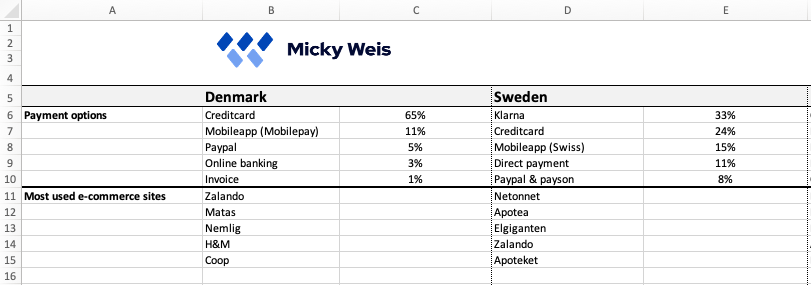
Many have asked if I would share it, and this is simply my own data pulled from various online analysis tools.
Download my full Excel file for international expansion
Tip: Want to find out which countries to expand to? Try scaling your ads before building country-specific webshops. If you have a Danish shop, test Google, Facebook & Instagram ads across the Scandinavian market. They can easily buy from a Danish webshop. You will quickly see which countries respond most to your advertising and then decide accordingly. The same strategy works in Europe if you have an English webshop. Exclude the UK, Norway, and Switzerland due to customs barriers. Choose countries carefully instead of targeting all of Europe. You can also check search volumes via Google Trends or Keyword Planner, or look at competitors’ ads on Facebook ads library.
Onsite optimization
On-site marketing eller optimering om man vil, bliver tit overset i iveren på at hente mere trafik. Hvad nu hvis du blot kunne få bare 1% til at købe mere? Der findes så mange muligheder hvorpå man kan optimere allerede eksisterende trafik.
On-site optimization
- A/B split testing (VWO.com)
- Mobile friendliness (can be tested for free in Search Console)
- Core Web Vitals (free via Search Console)
- Speed – (test your site via Google here). Other tools: GTmetrix
- Menu navigation – are the most important pages easy to find?
- Improved onsite search experience (consider Clerk or Klevu)
- AI size guide (Fit Finder Analytics)
Conversion optimization
All onsite optimization can basically be categorized as conversion optimization. The principle is that you test a hypothesis where one change will yield more conversions than the current version, by running an A/B split test. That means 50% of your traffic sees the original version, while the other 50% sees the new one.
The system then reports which version performed best based on the goal you set, such as sales.
- Product videos
- Onsite “wiki” for customers to reduce support emails
- Optimize the “thank you for your order” page
- Bundle products into packages
- Survey after checkout
- Create a helpful 404 page
- Product recommendation (Clerk)
- Annual vs. monthly payment
- Installment options (Viabill / Klarna)
- Extend return period
- Product reviews (automated via email flows)
- Certificates such as Trustpilot, eco, e-mærket
Systems for onsite optimization I have used or recommend
- Yourvisuals.dk – product videos
- VWO – A/B split testing (alternative: Optimizely)
- Surveymonkey – surveys
- Clerk.io – search / product recommendations
- Klevu.com – search / alternative to Clerk
- Hotjar.io – records user mouse movements
- Mouseflow – similar to Hotjar, personal preference
Tip: Don’t let subjective opinions decide what is “beautiful” or not. I’ve consulted companies where three graphic designers each had different views. The challenge is that none of them are truly right. Sometimes even CEOs want effects like “snow falling on the screen.” Don’t. Let data and systems decide what works best. Early on in your webshop journey, conversion optimization should not be the primary focus. Your task at this stage is to drive qualified traffic. Without enough traffic, you cannot get valid test results.
Offline marketing
I often find offline marketing underrated. At one point it was overpriced, but then online marketing came along and took part of the budget – suddenly offline prices dropped.
- Bus ads
- Event sponsorships
- Newspaper ads
- Radio ads
- Direct flyer distribution
Tip: Think creatively. Sometimes offline marketing can become online marketing. People take more photos than ever. We saw it during the Super Bowl with Coinbase’s QR code bouncing across the screen. I believe combining these two verticals is a unique opportunity. I really miss creativity in modern marketing. Data is good, but if you really want to stand out, creativity is essential. I’ve always found inspiration in Mathilde and Tonny, the founders of Sinful. Their creative approach has always been extremely inspiring.
Data analysis
Data analysis might not be considered a direct “marketing tool,” but it is probably the most important if you want control over your marketing. There are countless systems in the world. All claim theirs will solve all your problems.
In principle, you only need a few tools to manage your business. What matters is that the numbers you track are relevant and that you know how to analyze them. For this, I recommend the first Excel sheet you may have downloaded from this post.
Two rules about data before we continue to systems:
- Always have a universal access email at the highest level “[email protected]” as backup.
- Save all passwords in systems like Onepassword or Nordpass and grant access based on role level.
Systems I use for data analysis
- Google Tag Manager – free (the first thing to install, as all other tags should be set up here)
- Google Analytics – free (still the basic tool for most websites)
- Google Search Console – free (technical tool mainly for SEO)
- Google Data Studio – free (can visualize data in dashboards)
- Dashthis – dashboard system (cheap, with many standard integrations for beginners)
- CDP (Segment, Custimy) – expensive tools, but good if your company has grown large enough
- Attribution (Dreamdata.io, Odyssey) – my best suggestions for solving attribution challenges in B2B & B2C
- External data (DMI) – often undervalued. External factors can directly impact your business. DMI weather data is a good example. Similarly, “covid-19” will serve as an example in the future of something with major influence. We tend to forget quickly, so already now we’re wondering why sales are lower than during the pandemic, when the explanation is quite simple.
Tip: Stick to a few systems. I see too many people jump from one system to another searching for “the magic one.” It doesn’t exist. A system is only as good as your skills in using it. If you don’t have the time to dive deep, don’t invest in it. If you feel overwhelmed by all these data tools, try experimenting with the Google Analytics demo account.
Loyalty systems
Loyal customers are worth their weight in gold. That much is obvious. But many businesses are so focused on getting new customers that they forget their existing ones. In most cases, acquiring new customers is much more expensive than retaining current ones.
That’s why customer care and loyalty are crucial. We can call it our “retention rate” – how well we keep customers coming back. There are several things you can do to increase loyalty. The most obvious is great customer service, as mentioned earlier. People buy where they feel treated well. Often, just one bad experience is enough for them to leave.
What else can you do for loyalty?
- Facebook group (the easiest way to create ambassadors)
- Getreferral (build your own referral system)
- Points program (like on Coolshop, where customers earn points)
- Email flows that acknowledge your most loyal customers
- Exclusive events for top customers
Tip: I believe loyalty is one of the most undervalued areas of marketing today. You can be great at acquiring new customers, but if you don’t retain them, it’s like having a boat with holes in the hull – eventually, it sinks. Be aware of how often your customers shop, what else you can sell them to increase frequency, and whether your boat is “leaking.”
In e-commerce, leakage means: are your customers shopping less and less over time? This is a crucial KPI to track because you can stop the leak if you identify it early.
Marketplaces
I’ve been fortunate to work with this area across borders. I’ve given talks abroad and worked with large webshops in different regions. My time in the Middle East was particularly interesting because their way of doing e-commerce is radically different from most of Europe.
One thing stands out more than anything else internationally: marketplaces like Amazon. It’s a fantastic showcase – offering both sales and branding opportunities.
Here are just a few of the biggest, though many more exist. My recommendation is to find the ones relevant in your target market.
- Amazon (read my full guide to Amazon here)
- Taobao (major platform in China – find a local partner/agency here)
- Noon (large platform in the Middle East)
- Souq (major Middle Eastern site – now owned by Amazon)
- Mercado Libre (South America)
- Walmart (Amazon’s competitor in the US, only in the US)
Tip: Many of these marketplaces are extremely complex to get started on. If you don’t have the time, find an external agency. In Europe, I recommend Jérôme, who runs an Amazon agency. I’ve tried Amazon myself, and it’s very time-consuming. Once you’re up and running, sales volume can be massive, but the setup is tough. If you want to enter a new country, research which marketplaces are relevant – they can be the key to success early on.
I want it now! Trend
We can debate whether it’s healthy for our stress levels that everything must be available instantly. Regardless, this is a trend I believe will explode – let’s call it “I want it now.”
We already see it in Denmark in small steps, for example with Wolt and Hungry delivering more than just food. Abroad, it’s much bigger. These delivery services can provide products within minutes, thanks to their existing logistics setup.
When I lived in the Middle East, Instashop was extremely popular, and I used it many times. Once, when I was sick, I ordered medicine and supplies from a local pharmacy – they were at my door 15 minutes later.
There are countless similar services worldwide. Again, I recommend finding those active in your market. You might even become a first-mover in your industry. That doesn’t make it a bad idea – in fact, it’s often cheaper to test early than when the platforms are already established.
Some examples I’ve used:
- Gorillas
- Instashop
- Milkrun
- Goflink
- Instacart
- Glovo
Tip: In the future, I believe we’ll see apps where you can simply write in free text: “I want to order 2 bags of popcorn, 2 Pepsi Max, 1 box of Panodil, I’d like to pay between 70–90 DKK, and it must be delivered tonight before 9 pm.” The specific service can then assign the “order” to their network of delivery workers – sometimes even to someone already en route with another delivery. Glovo already offers this type of service in Spain, and we tested it during a trip to Marbella – our popcorn arrived exactly as requested.
Alright… we made it!
If you made it this far, I’m truly grateful – but even if you only got halfway, that’s fine too. The most important thing is that you took away a few new ideas.
Something you could use. I also hope you downloaded some of the material along the way.
Have I missed any areas? Are there strategies that should be added, or have I written something unclear?
The comment section below is yours. Otherwise, I simply want to wish you a great day, and thank you again for taking the time to read this.
FAQ: The essentials to scaling your business
How do I prioritize between 100+ different marketing tactics when scaling?
When you’re staring at a massive list of strategies, the key is to cherry-pick the ones that fit your current situation and drop them into a spreadsheet.
You need to map out your efforts based on priority and resources, so you don’t drown in “options” but actually execute the most important tasks first.
By structuring your marketing data logically, you create a 12–24-month roadmap where you can actually see what’s working.
It’s all about stripping things back to basics and focusing on the areas where you can actually move the needle and feel the impact immediately.
What role do external factors play in data analysis?
We forget things fast, so it’s vital to keep a quick monthly log in your analytics to avoid information overload.
I always factor in external data, like weather patterns; a heatwave can hit online sales just as hard as a pandemic.
Without that context, you’ll end up staring at a 50% drop in your index and wondering what went wrong.
Data only makes sense if you understand the reality that created the numbers in the first place.
Is email marketing still effective for scaling a modern webshop?
Email isn’t going anywhere; in fact, it’s still one of the absolute best channels for driving direct revenue.
However, customers expect more today, so you need to use smart automation flows based on behavior; think “abandoned cart” or “winback” series.
Building your email list is a goldmine but use pop-ups wisely so you don’t kill your conversion rate or annoy mobile users.
It’s all about personalization and hitting the customer with the right message at exactly the right time.
How do I test the potential of a new international market as fast as possible?
Before you build a full-scale localized webshop, test the waters by expanding your existing Google, Facebook, and Instagram ads to the new country.
See which markets “trigger” the most interest before making the big leap into full internationalization.
It’s a fast way to validate demand, provided you have the basics like shipping, customs, and payment solutions under control.
What’s the most overlooked strategy for increasing revenue without buying more traffic?
On-site and conversion rate optimization (CRO) are often ignored in the rush to get new traffic, but this is where you truly move the bottom line.
By using A/B testing, you let data decide which changes actually make people buy more, rather than relying on gut feelings or a designer’s opinion.
Small tweaks like product videos, better search functionality, or bundles can drastically change your performance.
Just don’t over-optimize until you have enough traffic for the numbers to actually tell the truth.
How do I use influencer marketing effectively without wasting my budget?
Most people fail at influencer marketing because they don’t find the right approach that fits their specific goals.
There’s a world of difference between using top-tier influencers for branding and micro-influencers for driving immediate sales via unique discount codes.
Use tools to check the real data behind their profiles so you know exactly what you’re buying into.
It’s a tough nut to crack, but once you find the right chemistry, it’s a channel that can seriously accelerate your growth.
Why is customer service a critical part of a scalable marketing strategy?
Customer support isn’t just firefighting; it’s a shortcut to invaluable insights, if you feed those customer lessons back to your marketing team.
By being present where your customers are, whether that’s live chat, social media, or Google Business, you build the trust necessary to scale.
It’s about creating great experiences that keep people coming back again and again.
What’s the best way to handle marketing data across multiple channels?
Stick to a few effective systems and stop jumping from platform to platform looking for a “magic” solution.
Start with Google Tag Manager to get your tags in order, then use Google Analytics to visualize your key KPIs.
It’s more important to understand the numbers you’re looking at than to have the most expensive tech stack.
Nowadays, it’s also crucial that you “own” your data. As tracking via cookies gets harder, you need to build your own knowledge through email lists and direct customer contact.
That way, you’re not totally at the mercy of the algorithms if they suddenly change the rules.
What is the advantage of affiliate marketing in a competitive market?
Affiliate marketing is a brilliant way to get “free” branding because you usually only pay a percentage (often around 20%) when an actual sale happens.
In industries where a few partners dominate the top search results, it can be the fastest route to visibility and revenue.
However, you have to do your homework on the systems and figure out what it takes for those affiliates to pick your products over everyone else’s.
How do I ensure customer loyalty and high retention for my store?
Loyal customers are the foundation of your business.
If you’re constantly losing the customers you fought so hard to acquire, you’ll eventually run out of steam.
You can build brand advocates through tight communities like Facebook groups or by using loyalty points and personalized email flows.
It’s much cheaper to keep an existing customer than to buy a new one, so track your retention rate religiously.
Keep an eye on whether customers are engaging less over time so you can step in with the right retention strategy before they disappear.



Comments